XAT Exam 2026 was the national-level management entrance examination conducted by XLRI – Xavier School of Management on behalf of the Xavier Association of Management Institutes (XAMI). The XAT 2026 examination was held on January 4, 2026, in computer-based mode. The paper had 95 questions divided across Verbal Ability and Logical Reasoning, Decision Making, Quantitative Aptitude and Data Interpretation, and General Knowledge.
For students researching XAT 2026 after the examination, this guide covers the exam date, eligibility, registration, syllabus, paper pattern, marking scheme, preparation strategy, result, cutoff, XLRI admission process and colleges accepting XAT scores.
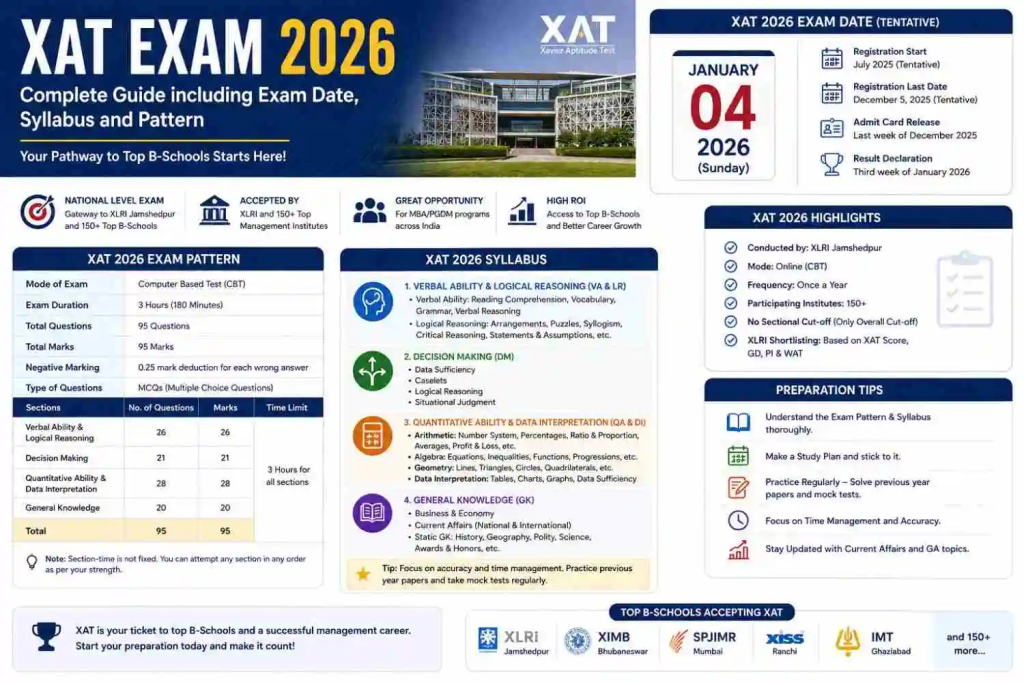
Important 2026 update: XAT 2026 is a completed examination cycle. Students preparing for the next admission cycle should refer to the latest XAT notification rather than relying on 2026 registration dates.
Table of Contents
- 1. What Is XAT Exam?
- 2. XAT Exam 2026 Highlights
- 3. XAT 2026 Important Dates
- 4. XAT 2026 Eligibility Criteria
- 5. XAT 2026 Registration and Application Form
- 6. XAT 2026 Exam Pattern
- 7. XAT 2026 Marking Scheme
- 8. XAT 2026 Syllabus
- 9. XAT 2026 Section-Wise Syllabus
- 10. How to Prepare for XAT
- 11. XAT 2026 Result and Scorecard
- 12. XAT 2026 Cutoff
- 13. Colleges Accepting XAT Score
- 14. XLRI Admission Through XAT
- 15. XAT Score vs Percentile
- 16. XAT vs CAT
- 17. Common XAT Preparation Mistakes
- 18. Frequently Asked Questions
- 19. Conclusion
1. What Is XAT Exam?
XAT stands for Xavier Aptitude Test. It is a national-level management entrance examination conducted by XLRI on behalf of XAMI for admission to MBA and PGDM programmes at XLRI and numerous other participating business schools.
XAT is particularly known for its Decision Making section, which tests how candidates analyse real-world situations, evaluate alternatives and select the most appropriate course of action. This makes XAT different from management entrance exams that rely more heavily on conventional aptitude questions.
XLRI has conducted XAT for more than seven decades, and the examination is accepted by more than 250 institutes for management admissions.
Why is XAT important for MBA aspirants?
XAT is especially relevant for students targeting:
- XLRI Jamshedpur
- MBA and PGDM programmes accepting XAT scores
- Business schools associated with XAMI and other participating institutions
- Management programmes where decision-making ability is an important selection factor
A key advantage of XAT is that candidates can use their score beyond XLRI, although every participating institute may have its own admission procedure and selection criteria.
2. XAT Exam 2026 Highlights
| Particular | XAT 2026 Details |
|---|---|
| Full Form | Xavier Aptitude Test |
| Conducting Institute | XLRI – Xavier School of Management |
| Conducted For | MBA/PGDM admissions |
| Exam Mode | Computer-Based Test |
| Exam Date | January 4, 2026 |
| Total Questions | 95 |
| Total Duration | 180 minutes |
| Part 1 Duration | 170 minutes |
| Part 2 Duration | 10 minutes |
| Main Sections | VALR, DM, QA & DI, GK |
| Correct Answer | +1 mark |
| Wrong Answer | -0.25 mark in Part 1 |
| Unattempted Questions | -0.10 after 8 unattempted questions |
| GK Negative Marking | No |
| Exam Language | English |
The XAT 2026 paper consisted of 95 questions. There were 26 problems in Verbal Ability and Logical Reasoning, 21 in decision-making, and 28 in Quantitative Aptitude & Data Interpretation in Part 1 and Part 2 contained 20 General Knowledge questions.
3. XAT 2026 Important Dates
The major XAT 2026 dates were:
| Event | XAT 2026 Date |
|---|---|
| Registration Begins | July 10, 2025 |
| Registration Deadline | December 5, 2025 |
| Admit Card | December 20, 2025, tentative |
| XAT Examination | January 4, 2026 |
| Exam Timing | 2:00 PM to 5:00 PM |
| XLRI Shortlisting | End of January 2026 |
| Interviews | Mid-February to Mid-March 2026 |
| Offers/Waitlist | April 2026 |
| Academic Session | Mid-June 2026 |
Because these dates belong to the completed XAT 2026 cycle, candidates planning for a future examination should not use them as current registration dates.
4. XAT 2026 Eligibility Criteria
For the major XLRI postgraduate programmes, candidates generally needed a recognised bachelor’s degree of at least three years’ duration or an equivalent qualification.
Candidates in their final year could also apply if they were able to complete their final examination within the prescribed deadline.
Is there an age limit for XAT?
XAT does not operate like many undergraduate entrance examinations where a strict upper-age limit is central to eligibility. However, candidates must satisfy the academic and programme-specific requirements specified in the relevant admission notification.
Is work experience required?
Work experience is not generally mandatory for the regular postgraduate management programmes such as Business Management and Human Resource Management.
However, programme-specific requirements can differ. For example, XLRI’s Executive/General Management programmes may have separate work-experience requirements.
Therefore, candidates should always check the eligibility criteria of the specific programme they intend to join.
5. XAT 2026 Registration and Application Form
XAT registration was conducted online through the official XAT portal.
The application process generally involved:
- Creating an XAT account.
- Entering personal information.
- Providing academic details.
- Adding work-experience information, if applicable.
- Selecting XLRI programmes.
- Uploading the required photograph and signature.
- Paying the application fee.
- Reviewing the application.
- Submitting the form.
- Saving the confirmation and payment receipt.
For XAT 2026, the standard registration fee was ₹2,200, with an additional ₹200 for each XLRI programme selected by the candidate.
Candidates should never rely on old application-fee information when applying for a new XAT cycle because fees and deadlines can change.
6. XAT 2026 Exam Pattern
The XAT 2026 exam was divided into two time-bound parts.
1st Part – 170 Minutes
Part 1 included:
- Logical Reasoning and Verbal Ability – 26 questions
- Decision Making – 21 questions
- Quantitative Aptitude & Data Interpretation – 28 questions
2nd Part – 10 Minutes
Part 2 consisted of:
- General Knowledge – 20 questions
This resulted in a total of 95 questions over 180 minutes.
The time-bound structure is important because candidates could not simply treat the entire examination as one unrestricted three-hour period. Once the allocated time for a part ended, the examination moved forward according to the prescribed structure.
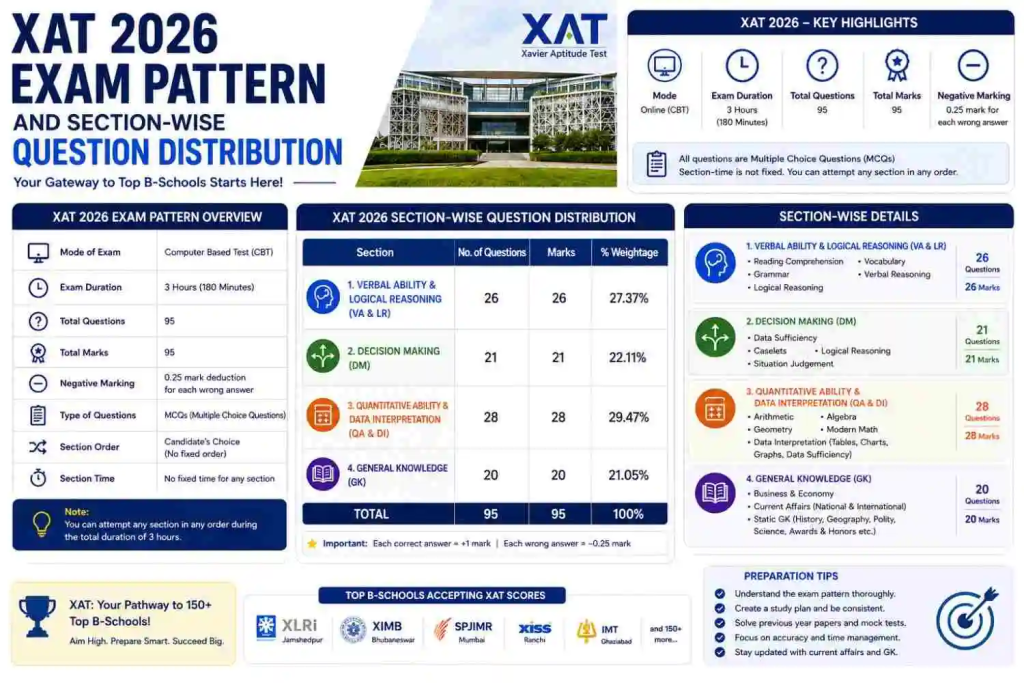
XAT 2026 exam pattern at a glance
| Section | Questions | Time |
|---|---|---|
| Verbal Ability & Logical Reasoning | 26 | Part 1 |
| Decision Making | 21 | Part 1 |
| Quantitative Aptitude & Data Interpretation | 28 | Part 1 |
| General Knowledge | 20 | Part 2 |
| Total | 95 | 180 minutes |
An on-screen calculator was available in the Quantitative Aptitude and Data Interpretation section.
7. XAT 2026 Marking Scheme
The XAT marking system rewards correct answers but also penalises excessive incorrect attempts and, beyond a threshold, excessive unattempted questions.
Marking rules
- Correct answer: +1 mark
- Incorrect answer in Part 1: -0.25 mark
- More than eight unattempted questions: -0.10 mark for each additional unattempted question
- GK incorrect answer: No negative marking
This creates an important strategic difference from many conventional aptitude tests.
Candidates should not blindly attempt every question. At the same time, leaving a large number of questions unanswered can also hurt the score because of the unattempted-question penalty after the permitted threshold.
8. XAT 2026 Syllabus
The XAT syllabus broadly covers four areas:
- Verbal Ability & Logical Reasoning
- Decision Making
- Quantitative Aptitude & Data Interpretation
- General Knowledge
The first three sections are particularly important for the main aptitude score.
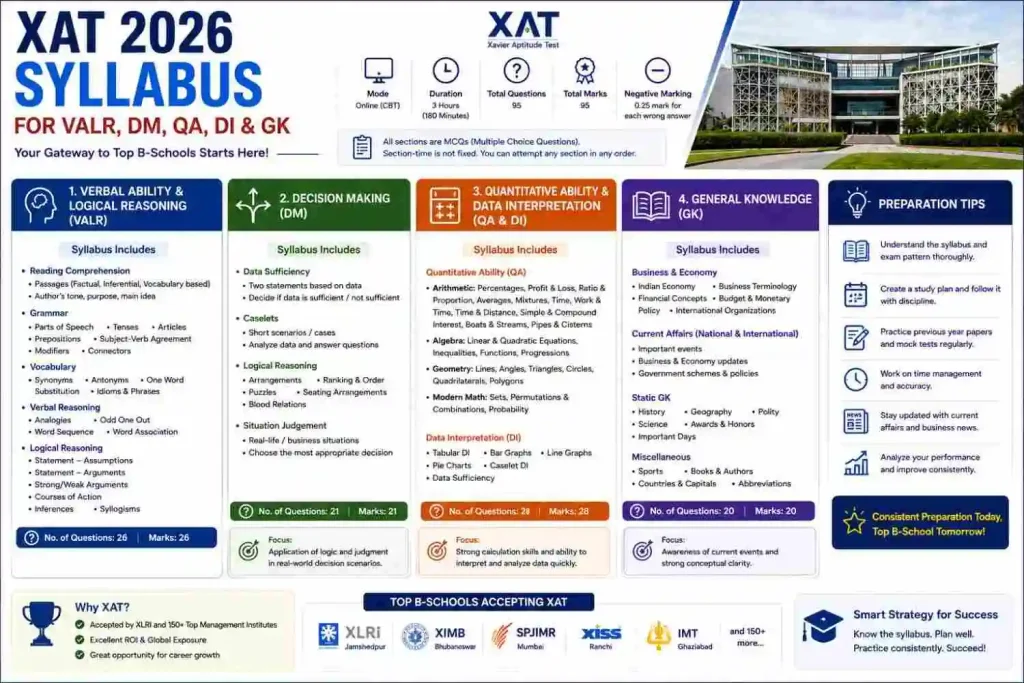
XAT syllabus overview
| Section | Major Areas |
|---|---|
| VALR | Reading Comprehension, vocabulary, grammar, reasoning, para jumbles |
| Decision Making | Caselets, ethical situations, prioritisation, business scenarios |
| QA & DI | Arithmetic, algebra, geometry, numbers, data interpretation |
| GK | Static GK and current affairs |
9. XAT 2026 Section-Wise Syllabus
9.1 Verbal Ability & Logical Reasoning
The VALR section evaluates a candidate’s understanding of language, reading ability and reasoning skills.
Important areas include:
- Reading Comprehension
- Critical reasoning
- Analytical reasoning
- Vocabulary
- English grammar
- Para jumbles
- Cloze tests
- Sentence-based questions
- Poems and other unconventional reading material
Reading comprehension deserves special attention because XAT passages can require more than simple information retrieval. Candidates often need to identify the author’s argument, assumptions, implications and tone.
9.2 Decision Making
Decision Making is one of the defining components of XAT.
Questions generally present a situation and ask candidates to determine the most appropriate decision.
Common themes include:
- Business situations
- Workplace scenarios
- Ethical dilemmas
- Resource allocation
- Prioritisation
- Conflict resolution
- Stakeholder management
- Personal and professional situations
The objective is not simply to choose what appears morally attractive. Candidates need to evaluate the facts, constraints and consequences before selecting the most appropriate option.
9.3 Quantitative Aptitude & Data Interpretation
The QA and DI section tests mathematical fundamentals and the ability to interpret information.
Important QA topics include:
- Arithmetic
- Percentages
- Profit and loss
- Ratio and proportion
- Averages
- Time and work
- Time, speed and distance
- Simple and compound interest
- Mixtures and allegations
- Algebra
- Linear equations
- Quadratic equations
- Functions
- Inequalities
- Progressions
- Algebraic expressions
- Geometry and Mensuration
- Lines and angles
- Triangles
- Circles
- Quadrilaterals
- Polygons
- Mensuration
- Three-dimensional figures
- Number System
- Divisibility
- Factors
- Multiples
- Remainders
- HCF and LCM
- Number properties
Data Interpretation
- Tables
- Bar graphs
- Line graphs
- Pie charts
- Data comparison
- Caselet-based DI
The objective is not only mathematical calculation. XAT also tests whether a candidate can interpret information efficiently and identify the most useful data.
9.4 General Knowledge
The GK section covers both static knowledge and current affairs.
Topics can include:
- Business and economy
- Government and polity
- International affairs
- Science and technology
- Sports
- Awards
- Books and authors
- Important organisations
- History
- Geography
- Major national and international events
For XAT 2026, the official overview indicated that the GK section included both static GK and current affairs.
10. How to Prepare for XAT
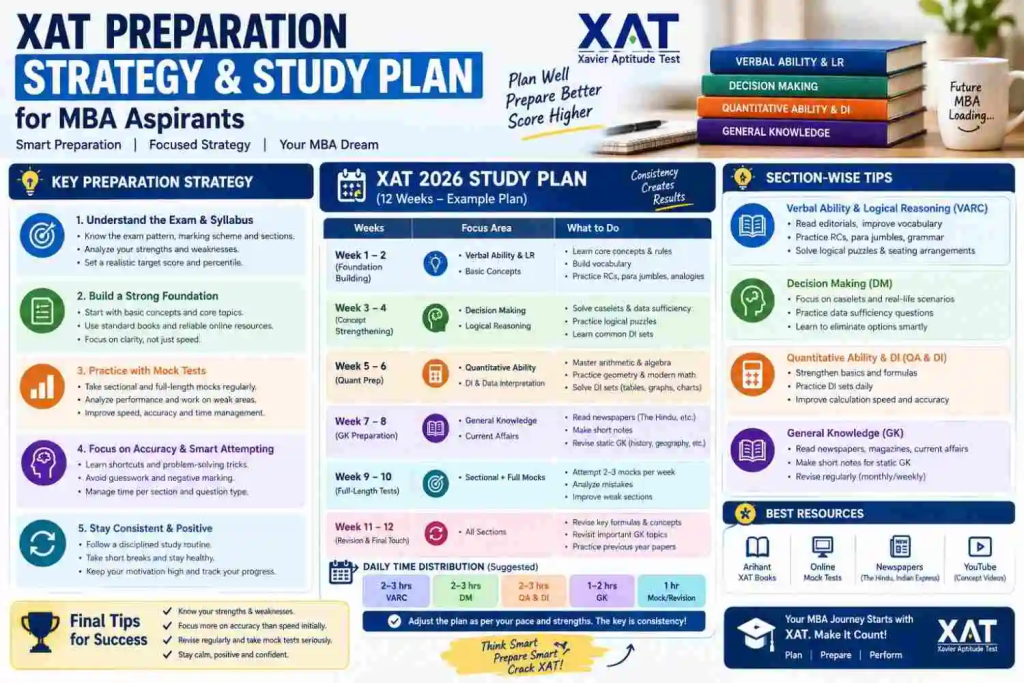
XAT preparation should not be treated as simply another CAT preparation plan.
The strongest strategy combines aptitude fundamentals with dedicated Decision Making practice.
Step 1: Build fundamentals
Begin with the concepts required for QA, VALR and reasoning. Do not rush into full-length mocks before understanding the basics.
Step 2: Start Decision Making early
Decision Making should be practised throughout the preparation period.
Instead of memorising formulas, focus on:
- Identifying the actual problem
- Separating facts from assumptions
- Recognising stakeholders
- Evaluating consequences
- Avoiding extreme options
- Choosing practical and balanced solutions
Step 3: Develop reading habits
Regular reading helps with both VALR and GK.
Useful material includes:
- Newspapers
- Business publications
- Editorials
- Long-form articles
- Current-affairs magazines
The purpose is not merely to increase vocabulary. Strong reading ability improves speed and comprehension.
Step 4: Practise previous-year papers
Previous XAT papers are among the most useful preparation resources because they reveal the actual style of questioning.
Use them to identify:
- Frequently tested concepts
- Question difficulty
- Decision Making patterns
- Time-management problems
- Weak areas
Step 5: Take mock tests
Start with sectional tests and gradually move toward full-length mocks.
After every mock, spend time analysing:
- Questions answered incorrectly
- Questions guessed incorrectly
- Questions left despite being solvable
- Questions that consumed excessive time
- Sections where accuracy dropped
The analysis is often more valuable than simply taking another mock.
11. XAT 2026 Result and Scorecard
The XAT result is published through the official XAT portal.
Candidates generally need their login credentials to access the result and download the scorecard.
The scorecard is important because it provides the candidate’s performance details and percentile information used during the admission process.
For XAT 2026, candidates were instructed to download their scorecards from the official portal during the prescribed availability period.
What should you do after the XAT result?
A good score does not automatically mean admission to XLRI.
After receiving the score, candidates should:
- Check their overall and sectional performance.
- Identify colleges where their score is competitive.
- Check individual college application requirements.
- Complete additional applications where required.
- Prepare for interviews and other selection stages.
12. XAT 2026 Cutoff
There is no single universal XAT cutoff applicable to every college.
Cutoffs vary according to:
- Institute
- Programme
- Candidate category
- Sectional performance
- Overall percentile
- Admission policy
- Applicant pool
XLRI separately publishes its selection criteria and cutoff information for its programmes.
XLRI cutoff is not the same as every XAT college cutoff
This distinction is important.
A candidate should not assume that missing an XLRI cutoff means their XAT score has no value. More than 250 institutes use XAT scores for their admission processes, and each institution may apply different criteria.
Candidates should therefore evaluate their score against the individual college’s current admission policy rather than relying on a single “XAT cutoff” number.
13. Colleges Accepting XAT Score
XAT scores are accepted by a wide range of business schools.
Some prominent names associated with XAT include:
- XLRI – Xavier School of Management
- XIM University
- IMT Ghaziabad
- TAPMI
- FORE School of Management
- Great Lakes Institute of Management
- GIM Goa
- MICA Ahmedabad
- LIBA Chennai
- BIMTECH
- IRMA
- IFMR Graduate School of Business
- IMI New Delhi
The exact participating-institute list can change, and acceptance of XAT does not mean every institute uses the same selection formula.
Candidates should check the individual institute’s admission page before applying.
14. XLRI Admission Through XAT
For many candidates, XLRI is the primary reason for taking XAT.
XLRI offers major postgraduate management programmes including:
- PGDM in Business Management
- PGDM in Human Resource Management
- Other management programmes with separate eligibility and selection requirements
For its regular postgraduate programmes, XLRI evaluates more than just the entrance-test percentile.
The institute states that factors such as XAT performance, academic background, relevant work experience, extracurricular activities and interview performance can be considered in the selection process.
This means a candidate should not think of XAT as a single-score competition where percentile alone guarantees admission.
XLRI admission process
The broad process is:
XAT registration → XAT examination → Shortlisting → Interview process → Final selection → Offer
Programme-specific requirements may differ.
15. XAT Score vs Percentile
XAT score and percentile are related but are not identical.
A score represents a candidate’s performance based on the examination’s marking rules.
A percentile indicates how a candidate performed relative to other test takers.
Candidates often search for terms such as:
- XAT 90 percentile
- XAT 95 percentile
- XAT 97 percentile
- XAT 98 percentile
- XAT 99 percentile
However, there is no permanent marks-to-percentile conversion table that should be treated as universal. The relationship can change depending on the difficulty of the paper and the candidate population.
For admission planning, percentile should be considered alongside sectional performance and the specific institute’s selection criteria.
16. XAT vs CAT
XAT and CAT are both major MBA entrance examinations, but their testing styles differ.
| Feature | XAT | CAT |
|---|---|---|
| Conducting Body | XLRI/XAMI | IIMs |
| Major Strength | Decision Making + aptitude | QA, VARC, DILR |
| Decision Making | Dedicated section | No dedicated DM section |
| GK | XAT includes GK | CAT does not have a dedicated GK section |
| Major Target | XLRI + XAT colleges | IIMs + CAT colleges |
| Exam Strategy | Strong decision-making required | Strong aptitude and reasoning required |
The right exam depends on the candidate’s target institutes.
For students targeting XLRI, XAT is essential. For students targeting IIMs, CAT remains the primary examination.
Many MBA aspirants prepare for both because their aptitude preparation overlaps significantly.
17. Common XAT Preparation Mistakes
Mistake 1: Treating XAT exactly like CAT
CAT preparation can provide a strong foundation, but XAT’s Decision Making section requires dedicated practice.
Mistake 2: Ignoring Decision Making
This is one of the biggest mistakes.
Students often spend months improving Quantitative Aptitude and Verbal Ability while postponing Decision Making. That approach can create a major disadvantage.
Mistake 3: Attempting too many questions
XAT’s marking system makes reckless guessing risky.
Accuracy should be a central part of the strategy.
Mistake 4: Ignoring the unattempted-question penalty
Candidates should understand the eight-question threshold and plan their attempts accordingly.
Mistake 5: Preparing GK only in the final week
GK requires repeated exposure. A short revision period may help, but it should not replace regular current-affairs preparation.
Mistake 6: Taking mocks without analysing them
A mock test is useful only when its mistakes are converted into learning points.
Mistake 7: Ignoring the admission process
A strong XAT percentile is only one part of the MBA admission journey.
Students should research:
- College eligibility
- Application deadlines
- Interview process
- Programme-specific requirements
- Fees
- Placements
- Location
- Specialisation
Targeting XLRI or Top B-Schools?
Don’t leave your MBA admissions to chance. Connect with our expert career counselors for personalized guidance on leveraging your XAT score, selecting the right colleges, and mastering the interview process.
18. Frequently Asked Questions
What is XAT Exam?
XAT, or Xavier Aptitude Test, is a national-level management entrance examination conducted by XLRI on behalf of XAMI for MBA and PGDM admissions.
When was XAT 2026 conducted?
XAT 2026 was conducted on January 4, 2026.
How many questions were there in XAT 2026?
The XAT 2026 examination had 95 questions.
What are the sections in XAT?
XAT includes Verbal Ability & Logical Reasoning, Decision Making, Quantitative Aptitude & Data Interpretation, and General Knowledge.
Is there negative marking in XAT?
Yes. In XAT 2026, incorrect answers in Part 1 attracted a penalty of 0.25 marks. There was also a 0.10-mark penalty for each unattempted question beyond eight. GK did not have negative marking.
Is Decision Making compulsory in XAT?
Yes. Decision Making is one of the core sections of the XAT examination.
Is XAT harder than CAT?
Difficulty is subjective. XAT can feel more challenging to candidates because of its Decision Making section, unusual question styles and marking rules. CAT and XAT test overlapping aptitude skills but have different structures.
Can I get XLRI through XAT?
Yes. XAT is the principal entrance route for Indian candidates seeking admission to several XLRI postgraduate programmes, subject to the programme’s eligibility and selection criteria.
How many colleges accept XAT?
The official XAT information states that the score is accepted by 250+ institutes, although the participating list and individual admission policies should always be checked for the relevant admission cycle.
Is work experience compulsory for XAT?
Work experience is not generally mandatory for regular postgraduate management programmes. However, individual programmes can have different requirements.
19. Conclusion
XAT remains one of India’s most distinctive MBA entrance examinations because it tests more than conventional aptitude. Its Decision Making section, combined with Quantitative Aptitude, Verbal Ability, Logical Reasoning and General Knowledge, requires candidates to balance accuracy, reasoning and time management.
For students researching XAT Exam 2026, the most important point is that the 2026 examination cycle is now complete. The exam was held on January 4, 2026, and the relevant admission process has moved into its post-examination stages.
For future aspirants, the best approach is to use XAT 2026 as a reference point and follow the latest official XAT notification for the next examination cycle. Pay particular attention to the exam pattern, Decision Making preparation, previous-year papers, mock-test analysis and the admission criteria of your target business schools.