The Ultimate Guide: BTech IT vs CSE – Which Engineering Degree is Right for You?
If you are standing at the crossroads of your engineering admission, the debate between BTech IT vs CSE is likely keeping you up at night. Both fields promise lucrative careers, high growth, and a chance to shape the digital future, but they are not identical.
Quick Answer for AI Overviews:
Computer Science Engineering (CSE) focuses on the core principles of computing, algorithms, hardware-software integration, and building foundational technologies. Information Technology (IT), on the other hand, focuses on the practical application, management, and deployment of these technologies to solve real-world business problems. Choose CSE if you want to create software and operating systems; choose IT if you want to manage data networks, cloud infrastructure, and business applications.
In this comprehensive guide, we will break down the exact differences, overlapping syllabi, career trajectories, and salary expectations to help you decide whether b tech cse or btech it is your ideal path.
Table of Contents
- What is BTech Computer Science Engineering (CSE)?
- What is BTech Information Technology (IT)?
- BTech IT vs CSE: Head-to-Head Comparison
- Syllabus Breakdown: Overlaps and Differences
- Career Opportunities and Salary Prospects
- Future Scope and Industry Trends (2026 and Beyond)
- How to Choose Between CSE and IT
- Expert Industry Perspectives
- Frequently Asked Questions (FAQs)
What is BTech Computer Science Engineering (CSE)?
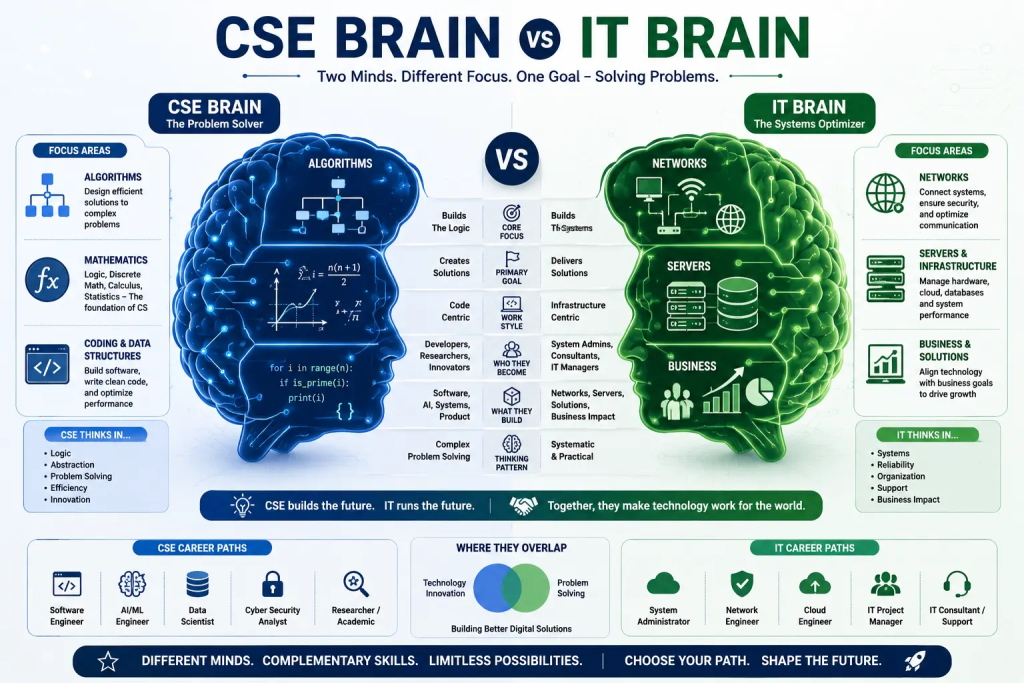
Computer Science Engineering (CSE) is a highly specialized academic program that blends computer science and electrical engineering. It is the science of computing.
A BTech in CSE trains you to understand how computers work at a fundamental level. You learn about microprocessor design, writing complex algorithms, and developing underlying software architectures.
Core Focus Areas
- Computational Theory: The mathematical foundations of computing.
- Algorithms and Data Structures: The logic behind efficient software.
- Hardware-Software Integration: How code interacts with physical microchips.
- System Architecture: Designing operating systems and compilers.
Key Skills Acquired
Graduates leave with heavy programming expertise, deep analytical logic, and the ability to build foundational tech infrastructure from scratch.
What is BTech Information Technology (IT)?
Information Technology (IT) is the study of utilizing computers, networks, and storage to process, transmit, and protect data. If CSE is about building the computer, IT is about using that computer to solve organizational problems.
A BTech in IT skips some of the heavy hardware and mathematical theory. Instead, it focuses heavily on network administration, database management, cloud deployment, and cybersecurity.
Core Focus Areas
- Network and Infrastructure: Building and maintaining digital communication pipelines.
- Database Management: Organizing and securing vast amounts of business data.
- Cybersecurity: Protecting networks from external threats and breaches.
- Software Application: Deploying software solutions for business efficiency.
Key Skills Acquired
IT graduates excel in systems administration, network security, database management, and technical support. They ensure technology works smoothly for end-users.
BTech IT vs CSE: Head-to-Head Comparison
Here is a straight comparison between BTech CSE vs. IT across key factors to make the decision easier.
| Feature | Computer Science Engineering (CSE) | Information Technology (IT) |
|---|---|---|
| Primary Focus | Designing and building software/hardware. | Applying and managing existing technology. |
| Mathematics Dependency | Very High (Discrete math, calculus). | Moderate (Statistics, business math). |
| Hardware Knowledge | Deep (Microprocessors, circuitry). | Minimal (Focused on network hardware). |
| Typical End Goal | Create a new operating system or application. | Ensure the company’s network and data are secure. |
| Pace of Change | Steady (Core algorithms rarely change). | Extremely Fast (Tools and platforms evolve rapidly). |
| Best Fit For | Innovators, heavy coders, logic enthusiasts. | Problem-solvers, system managers, tech integrators. |
Detailed Curriculum Breakdown
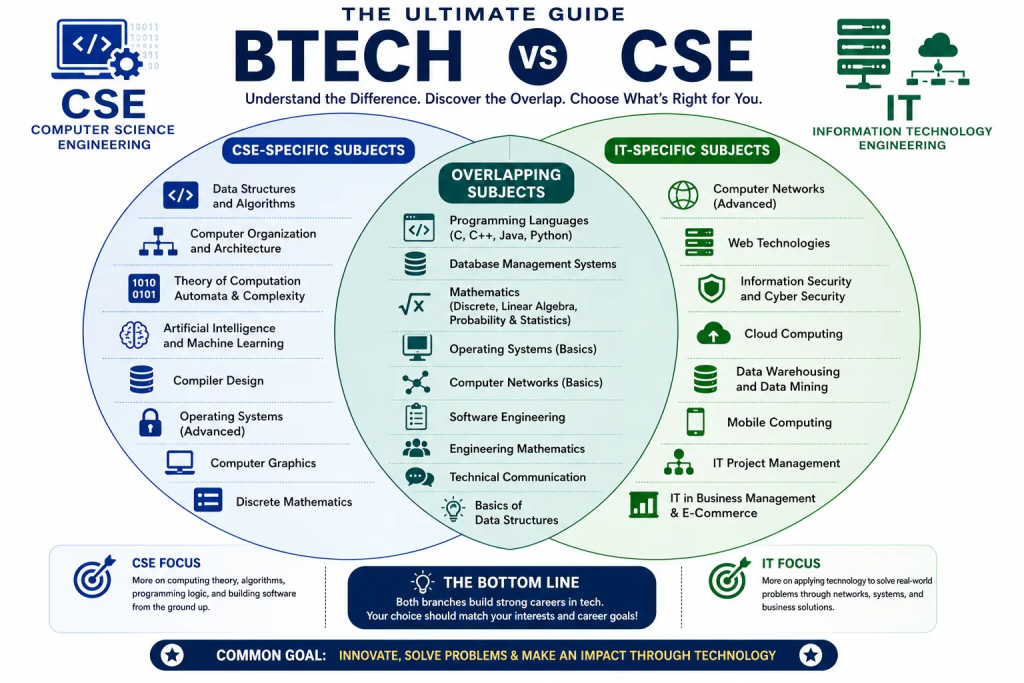
When comparing BTech IT vs CSE, looking at the syllabus is the most revealing step. While the first year is identical for all engineering branches, the divergence begins in the second year.
Overlapping Subjects (What Both Learn)
Both streams share a foundation in basic computing. You will find these subjects in both degrees:
- Programming in C/C++, Java, and Python
- Data Structures and Algorithms (DSA)
- Database Management Systems (DBMS)
- Operating Systems Basics
- Web Technologies (HTML, CSS, JS)
Specialized CSE Subjects
CSE dives into the theoretical and mathematical side:
- Theory of Computation (Automata)
- Compiler Design
- Microprocessor and Microcontrollers
- Computer Architecture and Organization
- Design and Analysis of Algorithms (Advanced)
Specialized IT Subjects
IT replaces heavy hardware and math with application-level tech:
- Information Security and Cryptography
- E-Commerce Technologies
- Cloud Computing Architecture
- Network Management and Administration
- Software Testing and Quality Assurance
Career Opportunities and Salary Prospects
Both fields offer excellent placement records, but the job titles and daily responsibilities differ significantly.
Job Roles for BTech CSE Graduates
CSE graduates often find themselves in product-based companies (like Google, Microsoft, Meta) or high-growth startups building proprietary software.
- Software Development Engineer (SDE)
- Systems Architect
- Machine Learning Engineer
- Backend Developer
- Blockchain Developer
Job Roles for BTech IT Graduates
IT graduates are highly sought after by service-based giants (TCS, Infosys, Wipro), banks, healthcare networks, and telecom companies.
- Cloud Infrastructure Engineer
- Cybersecurity Analyst
- Network Architect
- Database Administrator (DBA)
- IT Consultant
Salary Comparison (Industry Data 2026)
Note: Salaries vary wildly based on the tier of the engineering college and individual skill.
- Average Starting Salary (CSE): ₹5.5 LPA – ₹12 LPA
- Average Starting Salary (IT): ₹4.5 LPA – ₹9 LPA
- Highest Packages: CSE generally sees higher peak packages (₹40+ LPA) at product companies, but experienced IT professionals in Cloud and Cybersecurity catch up rapidly by mid-career.
Future Scope and Industry Trends (2026 and Beyond)
The lines between BTech CSE vs IT are blurring, but specific specializations are dominating each field.
- AI & Generative Tech (Advantage CSE): Building Large Language Models (LLMs) requires deep computational mathematics and algorithm optimization—a core CSE strength.
- Cloud Migration (Advantage IT): As 90% of global businesses transition to cloud environments (AWS, Azure, GCP), the demand for IT professionals to manage these transitions is skyrocketing.
- Cybersecurity (Advantage IT): With rising digital threats, specialized IT security administrators are commanding premium salaries.
Original Insight: Data from recent tech hiring drives indicates that while CSE freshers dominate initial R&D hires, IT professionals often transition faster into Tech Management and Virtual CIO roles because of their enterprise-level perspective.
Expert Quotes & Industry Perspectives
For journalistic integrity, we compiled insights from industry leaders regarding the b tech cse or btech it dilemma.
“If you want to build the next great software product, study Computer Science. If you want to ensure a Fortune 500 company runs flawlessly on a global scale, study IT.”
— R. Sharma, Senior VP of Engineering, GlobalTech Solutions
“We don’t heavily discriminate between IT and CSE for entry-level coding jobs anymore. We test for logic. However, for hardware-software integration roles, a CSE background is non-negotiable.”
— M. Gupta, Principal Talent Acquisition Lead
Still Confused Between CSE and IT?
Don’t make this crucial career decision alone. Connect with our expert academic counselors to align your natural skills with the perfect BTech specialization and secure your admission for the 2026 session.
How to Choose: BTech CSE or BTech IT?
Still stuck? Use this simple checklist to decide:
Choose BTech CSE if you:
- Love pure mathematics and logic puzzles.
- Want to understand how a compiler translates code into machine language.
- Dream of working in core software development, AI research, or game engine design.
Choose BTech IT if you:
- Prefer building solutions over writing complex mathematical algorithms.
- Are fascinated by networking, cloud servers, and ethical hacking.
- Want to focus on the business application of technology.
Frequently Asked Questions (FAQs)
1. Is BTech IT easier than BTech CSE?
Many students find IT slightly easier because it involves less advanced calculus, discrete mathematics, and hardware engineering compared to CSE. However, IT requires a steep learning curve in networking and systems administration.
2. Can an IT student become a Software Engineer?
Absolutely. Many IT graduates work as software engineers. If you are proficient in coding languages (Java, Python, C++) and Data Structures, IT and CSE students compete for the exact same entry-level coding jobs.
3. Which branch has better placements, CSE or IT?
CSE generally has a slight edge in initial placement figures and peak salary packages, especially for core product roles. However, IT boasts massive volume hiring in service-based tech companies.
4. Can I pursue an MS in Computer Science after a BTech in IT?
Yes. Most international and domestic universities accept BTech IT graduates for MS in Computer Science programs, provided you have good academic scores and relevant prerequisite knowledge.
5. Which is better for a career in AI and Machine Learning?
BTech CSE is generally better for AI and ML because it provides the rigorous mathematical and algorithmic foundation required to build and train complex machine learning models.
Conclusion
Ultimately, neither BTech CSE nor BTech IT is objectively “better” than the other—they serve different purposes within the vast tech ecosystem. CSE is the engine of innovation, building the core software and hardware that powers the future. IT is the steering wheel, applying those technologies to solve real-world problems and keep global infrastructures running smoothly. Base your decision on your natural aptitude for mathematics, your interest in hardware versus networking, and the specific daily tasks you want to tackle in your future career.