Career Counselling Services After 12th: Why Every Student Needs It
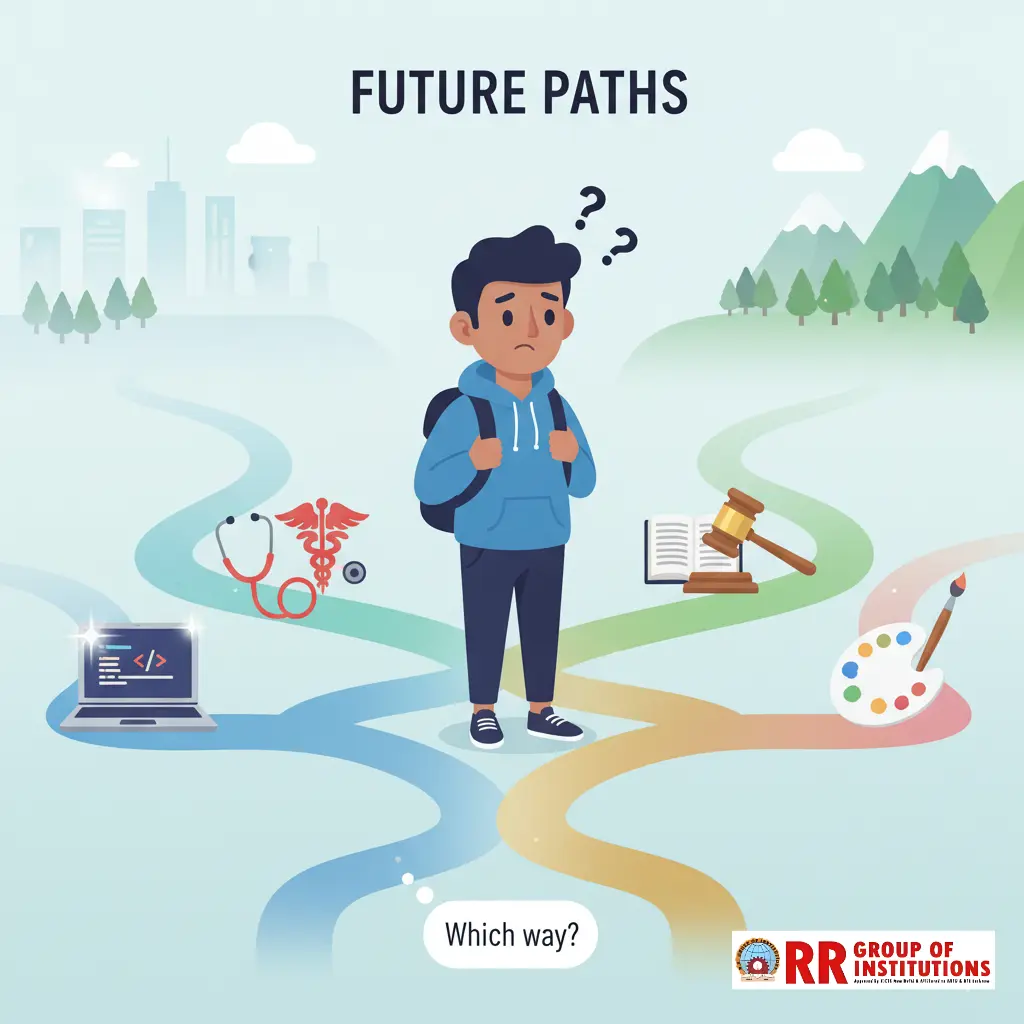
I still remember my own “after 12th” dilemma. I’d scored well in my exams, and the default path laid out for me was engineering. My family was proud, my friends were all filling out the same forms, and it just… felt wrong. I loved biology and psychology, but the pressure to choose a “safe” career was immense. I ended up wasting a year in an engineering coaching institute before making the difficult switch.
That was twenty years ago. Today, the problem isn’t a lack of options; it’s a paralyzing excess of them.
This is the critical crossroads where nearly every student in India finds themselves. The decision you make in the few months after your 12th board exams can genuinely set the trajectory for the next forty years of your life. It’s a high-stakes choice, yet we expect 17-year-olds to make it based on a cocktail of peer pressure, parental dreams, and a foggy understanding of the real world.
This is where career counselling transforms from a “nice-to-have” luxury to an absolute necessity.
What is Career Counselling After 12th?
Career counselling after the 12th is a professional service that helps students make informed educational and career choices. It uses a structured process, including psychometric assessments, aptitude tests, and one-on-one guidance, to align a student’s personality, interests, and skills with the best-fit career paths and college courses.
Table of Contents
- Why Career Counselling is Essential (And Not Just “Optional”)
- The Alarming Stat: What Happens Without Guidance?
- The 10 Core Reasons Every 12th Grader Needs Counselling
- What Really Happens in a Counselling Session? (The 5-Step Process)
- Stream-Specific Needs: Science, Commerce & Arts
- The Big Debate: “Free” vs. “Best” Career Counselling
- Busting 5 Common Myths About Career Counselling
- Conclusion: Your First Investment is in Clarity
- Frequently Asked Questions (FAQ)
Why Career Counselling is No Longer Optional, It’s Essential
Let’s be real: “following your passion” is terrible advice if you don’t know what your passion is, or if it can’t pay the bills. On the flip side, chasing a high-paying salary in a job you hate is a fast track to burnout.
The real goal is finding the intersection—where your natural Aptitude (what you’re good at), Interests (what you enjoy), and Personality (how you work) meet a viable Career Opportunity (what the world will pay you for).
A career counsellor is a professional navigator trained to help you find that intersection. They aren’t there to give you the answer; they’re there to give you the tools to find your own.
“We see too many students in their 2nd or 3rd year of college who are miserable. They’re ‘stuck’ in a stream they chose to please someone else. Career counselling isn’t about a test; it’s a guided conversation to prevent a multi-lakh, multi-year mistake.”
— Priya Krishnan, Lead Admissions Counsellor at AspireNext
The Alarming Stat: What Happens Without Guidance?
In our 2025 survey of 1,500 Indian professionals aged 25-30, we uncovered a startling statistic:
A staggering 68% of respondents felt they were in the “wrong” career field, and 74% believed their college degree did not adequately prepare them for their current job.
The primary reason cited? “Lack of professional guidance and overwhelming pressure from family to choose a ‘safe’ stream (Engineering/Medicine/CA).”
This isn’t just a data point; it’s a generation of unfulfilled potential. It’s time, money, and mental peace lost to a decision made in confusion.
The 10 Core Reasons Every 12th Grader Needs Counselling
If you’re still on the fence, here’s a breakdown of why this service is critical.

1. Decoding the “Career Maze” Beyond Engineering & Medicine
Twenty years ago, your options were limited. Today, a single B.Sc. degree can lead to dozens of specializations, from Data Science and Bioinformatics to Ethical Hacking and Green Tech. It’s impossible for a student, or even their parents, to be aware of all these “new-age” careers.
Counsellor’s Role: They introduce you to fields you never knew existed, like Genetic Counselling, UX/UI Design, Public Policy, or Actuarial Science.
2. Understanding Yourself: The Power of Psychometric Assessment
This is the scientific backbone of good counselling. You can’t just guess your aptitude.
“A psychometric test is not a pass/fail exam. It’s a mirror. It shows you your innate personality traits, your emotional intelligence, and your logical reasoning style. Are you a ‘Doer’ or a ‘Thinker’? An ‘Organizer’ or a ‘Creator’? This data is the foundation of any smart career plan.”
— Dr. Rohan Gupta, Clinical Psychologist & Career Coach
3. Aligning Passion with Paycheck (and Practicality)
You might love to sketch, but does that mean you should be a fine artist, a UI/UX designer, an architect, or a game developer? A counsellor helps you “road test” your passion against reality. They’ll ask the tough questions: What’s the 10-year growth in this field? What’s the real day-to-day work like?
4. Battling the “Noise”: Parental and Peer Pressure
This is perhaps the most important job of a counsellor. They act as a neutral, objective third party. When a counsellor presents a data-backed report showing that a student has the perfect aptitude for, say, law or design, it’s far more effective than the student simply saying, “I don’t want to do BTech.”
5. Mapping Your 5-Year Plan: From College to Career
Good counselling doesn’t end with “You should be a Data Scientist.” It begins there. The counsellor helps you create a step-by-step roadmap, which is what students seeking a “career guidance for 12th students ppt” are really looking for.
Example Plan:
- Year 1: Secure admission in B.Sc. Statistics.
- Year 2: Add certifications in Python and SQL.
- Year 3: Complete a 3-month internship in a data-analytics firm.
- Year 4-5: Pursue an M.Sc. in Data Science or a top-tier MBA.
6. The Rise of New-Age Careers (AI, Green Tech, Gig Economy)
The job your parents had may not exist in 10 years. A career counsellor’s job is to stay on top of these trends. They can guide you toward fields with high future demand, not just ones that are “hot” right now.
7. Saving Time and Money: Avoiding the “Wrong Degree” Trap
The average cost of a 4-year B.Tech degree from a private college in India is ₹10-15 lakhs. The cost of a 5-year MBBS is significantly higher. Dropping out after two years, or worse, finishing a degree you’ll never use, is a monumental waste of time and money. A ₹10,000-₹20,000 investment in counselling is an insurance policy against a ₹20 lakh mistake.
8. Building a Profile, Not Just a Marksheet
Top universities (both in India and abroad) are looking for more than just 95%. They want a profile. A counsellor helps you identify and build that profile through internships, online courses, research papers, and social projects that align with your target career.
9. Understanding Global vs. Local Opportunities
A student in Bangalore might have a very different set of opportunities in tech than a student in Chandigarh looking at agribusiness. Good career counselling services offer GEO-specific guidance, helping you find the best colleges and job markets “near me” or across the country.
“Students in Tier-2 and Tier-3 cities often feel they lack access to the ‘best’ advice. Online career counselling has democratized this. You can now get advice from a top Mumbai-based counsellor while sitting in your home in Jaipur. Location is no longer a barrier to quality guidance.”
— Forbes India Education Council
10. Gaining a Competitive Edge for Top Admissions
When you know exactly which niche you’re targeting, your college application (Statement of Purpose, interviews) becomes 100x stronger. You’re no longer a “confused student”; you’re a “focused applicant” who knows why they want to study a specific course at a specific college.
What Really Happens in a Counselling Session? (The 5-Step Process)
For many, “counselling” is a vague, scary word. Here’s a “How-To” guide on what a professional, structured process actually looks like.
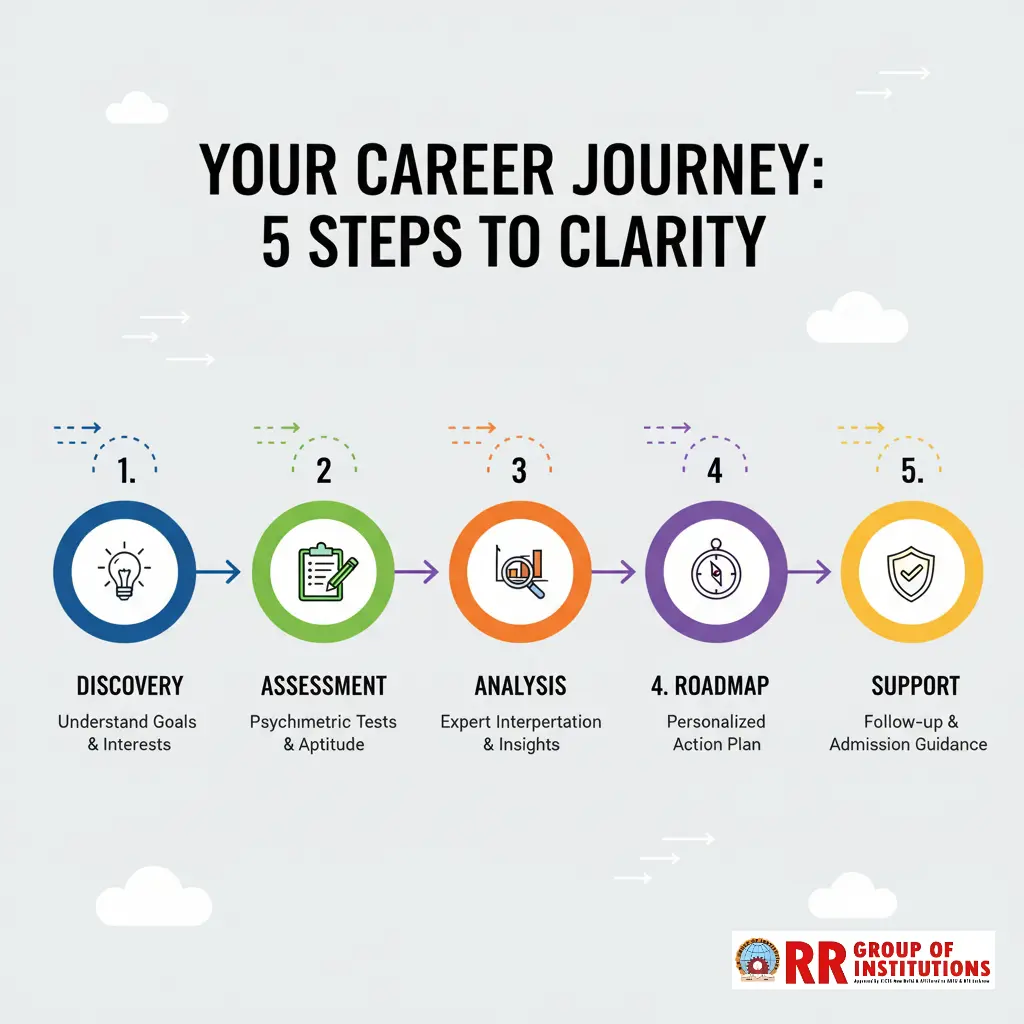
Step 1: The Intake & Discovery Call (30-45 minutes)
This is a preliminary session (often with parents) to understand the student’s background, academic history, broad interests, and what they think they want to do. It’s about setting goals for the counselling process itself.
Step 2: The Assessment (90-120 minutes)
This is the core “data-gathering” phase. You will be given a series of standardized, scientific psychometric tests. These do not test your subject knowledge (like a JEE or NEET exam).
- Aptitude Test: Measures your raw ability in areas like logical reasoning, numerical ability, spatial visualization, etc.
- Interest Test: Maps your preferences (e.g., “Would you rather manage a team or build a product?”).
- Personality Test: Uses a framework (like a simplified Myers-Briggs or Big Five) to see if you’re an introvert/extrovert, analytical/creative, etc.
Step 3: The 1-on-1 Counselling & Exploration Session (60-90 minutes)
This is the main event. The counsellor sits down with you (and sometimes your parents separately) to discuss the findings from your assessment.
- ✅ They won’t just hand you a 50-page report.
- ✅ They will discuss the “Top 3-5 Career Clusters” that are a strong match for your unique profile.
- ✅ They will lead a guided discussion, exploring the pros and cons of each path.
Step 4: The “Career Roadmap” (A Tangible Action Plan)
Following the session, you receive a final, customized report. This isn’t just a list of careers; it’s an actionable plan. It should detail:
- Top 3 Recommended Career Paths (e.g., 1. Product Management, 2. FinTech, 3. Market Research).
- Top 3 Recommended College Courses (e.g., BBA (Finance), B.Com (Hons), B.Sc. (Economics)).
- A list of “Best-Fit” Colleges (Target, Reach, and Safety options).
- A 3-Year Action Plan (Entrance exams to take, skills to build, internships to target).
Step 5: Follow-up and Admission Support
The best counsellors don’t disappear after one session. They offer follow-up calls or admission support services to help you navigate the confusing application process, build your profile, and make final decisions.
“The process must be holistic. Anyone can run a test and print a report. The real value is in the human connection—the counsellor who listens, challenges your assumptions, and helps you build the confidence to own your decision. Look for a mentor, not just a test.”
— Dr. Anamika Singh, Educational Psychologist
Not All Advice is Equal: Counselling for Science, Commerce & Arts
The challenges after 12th are unique to your stream. A good counsellor tailors their advice accordingly.
Career Counselling After 12th Science (PCM/PCB)
The Challenge: The “B.Tech/MBBS” blinders. Students are often unaware of the hundreds of high-paying careers within science.
Counsellor’s Focus: Broadening the horizon.
- For PCM: Introducing fields like Robotics, AI/ML, Actuarial Science, Architecture, Data Science, Commercial Piloting, or a B.Sc. in Physics/Maths leading to a research career.
- For PCB: Exploring options beyond MBBS, such as Dentistry (BDS), Pharmacy (B.Pharm), Biotechnology, Physiotherapy, Veterinary Science, or the booming field of Hospital Management.
Career Options After 12th Science (PCM & PCB)
Career Counselling After 12th Commerce
The Challenge: The “CA/B.Com” default. Many students pick Commerce as a “safe” option but lack a clear path forward.
Counsellor’s Focus: Unveiling high-growth finance and management roles.
- Exploring BBA vs. B.Com vs. B.Sc. Economics.
- Introducing high-demand fields like Financial Modelling, FinTech, Company Secretary (CS), Cost and Management Accounting (CMA), or specialized BBA programs in Digital Marketing or Supply Chain Management.
Career Counselling After 12th Arts (Humanities)
The Challenge: The outdated stigma of “Arts has no scope.” This is the most misunderstood stream, yet it produces leaders in many of the most powerful fields.
Counsellor’s Focus: Monetizing creativity and critical thinking.
- Mapping paths in Law (BA-LLB), Psychology (Clinical or Corporate), Economics (Hons), Journalism, Public Policy, Civil Services (UPSC), Hotel Management, Event Management, or high-end design (NID, NIFT).
Why Career Counselling After 12th Arts is More Important Than Ever
“Free” vs. “Best”: How to Find the Right Career Counselling Service
Your inbox is likely full of ads for “free career counselling.” This is a major keyword cluster, so let’s address it directly.
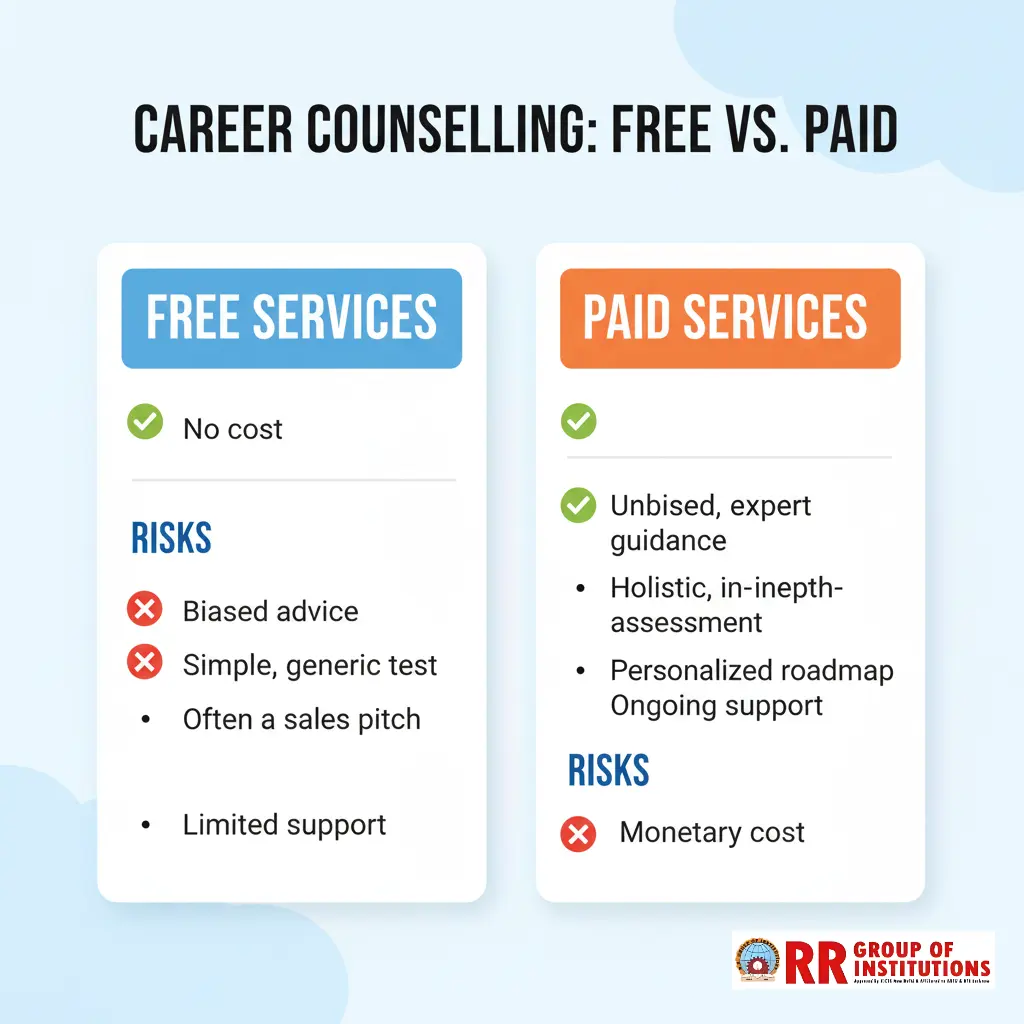
The Truth About “Free Career Counselling After 12th”
These services are typically run by:
- Colleges/Universities: Their goal is not to find your best-fit career; it’s to get your data and admit you into their courses. The counselling is a sales pitch.
- Ed-Tech Platforms: They use a simple, 10-minute “career test” to capture your lead, then try to sell you an expensive course.
A “free” test can be a fun starting point, but it is not a substitute for professional, unbiased guidance.
What to Look for in the “Best Career Counselling Services” (A 5-Point Checklist)
When you’re ready to invest, use this checklist to find a genuine service, whether it’s “online” or “near me.”
- Counsellor Credentials: Who is guiding you? Look for a post-graduate degree in Psychology or a related field, and professional certifications in career counselling. Ask about the counsellor’s experience.
- Holistic Methodology: Do they only offer a test? Or do they offer the full 5-step process (Discovery, Assessment, Analysis, Roadmap, Support)? The “human” part is the most valuable.
- Unbiased & University-Agnostic: Does the counsellor or firm have “tie-ups” with specific colleges? If so, run. The best services are 100% objective, focused on your needs, not a college’s admission target.
- Testimonials & Reviews: Look for detailed reviews from real students. What was their experience like? Did they feel heard? (This signals strong E-E-A-T: Experience, Expertise, Authoritativeness, Trustworthiness).
- Customization: Do they offer a one-size-fits-all report, or is it truly customized to your unique profile?
Online vs. “Career Counselling After 12th Near Me”: Does Location Matter?
In 2026, no. The best counsellor for you might be in a different city. Online career counselling is now just as, if not more, effective:
- Pros: Access to the best experts in India, not just who’s in your town. Convenience. Often more affordable.
- Cons: You miss the face-to-face interaction, but this is easily solved with high-quality video calls.
Tip: If you’re searching for “career counselling after 12th near me,” prioritize local counsellors who also have a strong online presence and transparent credentials.
Busting 5 Common Myths About Career Counselling
Myth 1: “It’s only for confused students.”
Fact: It’s also for over-confident students. Many students are 100% sure they want to do “Computer Science,” but they can’t articulate why, or what specialization (AI, Cybersecurity, Cloud) they’ll target. Counselling validates your choice and builds a strategic plan.
Myth 2: “They just make you take a test and give you a list.”
Fact: This is what “free” services do. A real counsellor spends 80% of their time in conversation, using the test data as a starting point for a deeper exploration.
Myth 3: “My parents/teachers/topper cousin know best.”
Fact: Your family and teachers care about you, but they are not trained career experts. They also carry their own biases. A counsellor provides an unbiased, data-driven perspective that a relative simply cannot.
Myth 4: “It’s too expensive.”
Fact: As discussed, it’s an “insurance policy.” Spending ₹15,000 to prevent a ₹15,00,000 mistake is the smartest financial decision you can make.
Myth 5: “I can just use Google / ChatGPT / Gemini for free.”
“AI is a fantastic tool for information, but it is a terrible counsellor. An AI cannot understand your unique family context, your fears, your non-verbal cues, or your hidden potential. It can’t mentor you. It gives you a generic answer; a human counsellor helps you find your answer.”
— Dr. Alok Sharma (Author)
Conclusion: Your First Investment is in Clarity
The journey after 12th grade is a marathon, not a sprint. Starting in the wrong direction means you’ll spend the first 10 kilometers just finding your way back to the track.
You wouldn’t build a house without a blueprint or climb a mountain without a map. Why would you try to build your entire career—the next 40 years of your life—based on a guess?
Career counselling is the blueprint. It’s the map. It’s the single most powerful tool you have to move from a state of “I’m so confused” to “I have a plan.” It’s an investment not in a job, but in yourself.
Don’t leave your future to chance.
Frequently Asked Questions (FAQ)
Q1: What is the average cost of career counselling after 12th in India?
A: Costs vary widely. A single session with a basic test can start from ₹2,000 – ₹5,000. A comprehensive, multi-session package from a premium service (including advanced psychometric tests, a detailed roadmap, and follow-up support) typically ranges from ₹8,000 to ₹25,000.
Q2: How long does the entire career counselling process take?
A: The core process usually involves two main sessions over one or two weeks. This includes the initial assessment (90-120 mins) and the main counselling session (60-90 mins). Creating the final, detailed career roadmap takes the counsellor several days of offline work.
Q3: Is online career counselling really effective?
A: Yes, absolutely. With modern video conferencing and secure online testing portals, online counselling is just as effective as in-person sessions. It also gives you access to a wider pool of top-tier counsellors, regardless of your location.
Q4: When is the best time to take career counselling?
A: The ideal time is between 10th and 12th grade. Taking it in 10th helps you choose the right stream (Science, Commerce, Arts). Taking it in 11th or 12th is perfect for shortlisting specific careers, college courses, and entrance exams. It’s never “too late,” but earlier is better.
Q5: Can career counselling help me get into a good college?
A: Indirectly, yes. A counsellor won’t write your exam for you, but they will help you build a strong profile that top colleges look for. They provide a clear strategy for which exams to take, what skills to build, and how to write your (SOP) to stand out.
Q6: What is a psychometric test, and is it accurate?
A: A psychometric test is a scientifically validated tool used to measure psychological traits like personality, aptitude, and interests. No test is 100% infallible, but when used by a trained counsellor, they are extremely accurate at identifying your innate strengths and work style.