How to Create Your Career Chart After 12th: A Step-by-Step Guide
Getting through your 12th-grade exams is a big deal. But it makes the most stressful question for a 17-year-old: “What now?”
Parents, teachers, and relatives all give you a lot of advice. Someone says engineering, another says law, and a third person says, “do something with computers” in a vague way. It doesn’t make sense. You probably found this page by looking for “career chart after 12th science pdf” or “best career options after 12th humanities,” and you were hoping for a simple JPEG that shows everything.
The truth is that a static, one-size-fits-all chart is the worst way to plan your future.
Your career isn’t a map that someone else drew; it’s a blank canvas. This article will do more than just give you a list of choices. It will show you how to make your own career chart, which is a dynamic tool that shows your unique skills, interests, and goals.
There are five steps to making a career chart: self-assessment, broad exploration, deep research, visualization (the chart itself), and making an action plan.
Table of Contents
- Why a “Career Chart” Trumps a Simple “Career List”
- Step-by-Step Guide: How to Create Your Career Chart
- Step 1: The Foundation – Know Thyself (Self-Assessment)
- Step 2: The Universe of Options (Broad Exploration)
- Step 3: The Filter – Deep Research & Reality Checks
- Step 4: The Blueprint – Visualizing Your Career Chart (with PDF Template)
- Step 5: The Launchpad – Creating Your 5-Year Action Plan
- Career Chart Deep Dive: Options After 12th Science (PCM & PCB)
- Career Chart Deep Dive: Options After 12th Commerce
- Career Chart Deep Dive: Options After 12th Humanities (Arts)
- Beyond the Big 3: Unique Careers & Government Jobs
- Frequently Asked Questions (Career Guidance After 12th)
- Conclusion: Your Career is a Marathon, Not a Sprint
Why a “Career Chart” Trumps a Simple “Career List”
A “list of career options” is not active. You scroll through it, but nothing happens. A career chart is open. It’s a personal research project that makes you take charge of your own future.
I’ve worked as a counselor for 15 years and have seen two kinds of students.
Student A (Priya), a student, downloaded a “career chart after 12th science pdf.” It said “Biotechnology.” She signed up for the course, but in her second year she realized she didn’t like lab work and was more interested in patent law.
Student B (Aman),made his own chart. He also looked into biotechnology, but his “Deep Research” step showed him the same thing about working in a lab. His chart helped him change his mind before making a decision. In the end, he got a BBA in Hospital Management, which was a great fit for his interests in healthcare and management.
A list lets you choose. A chart makes things clear.
Expert Insight: “Students often fall into the ‘shiny object’ trap, which is when they chase the career that sounds the best. Making a personal career chart makes them look at all of their options objectively, from their projected salary over the next five years to their daily work. It stops you from regretting your career.”
— Aditi Sharma, Head of HR at TechCorp
How to Create Your Career Chart in 5 Steps
This is the most important section of this article. Do this right, and you’ll be ahead of 90% of your peers.
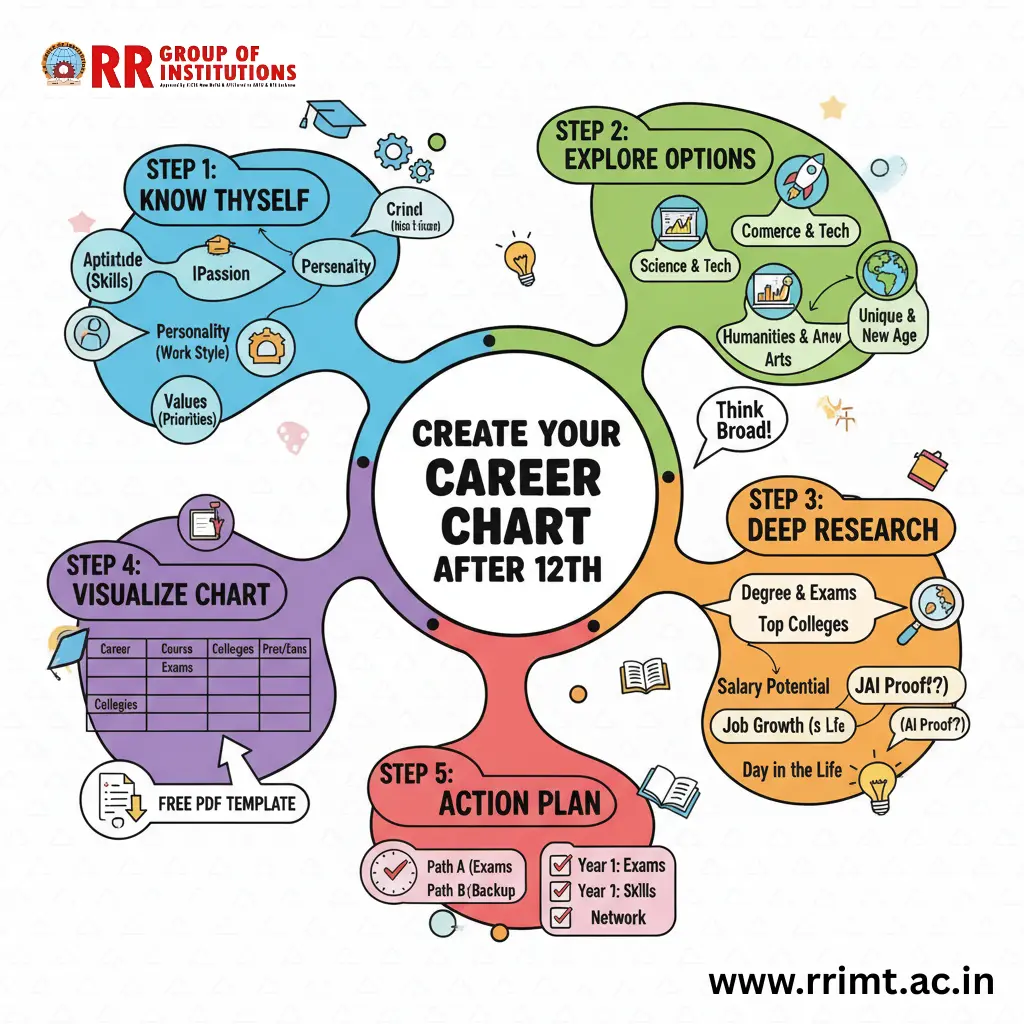
Step 1: The Foundation – Know Thyself (Self-Assessment)
You can’t find the right job if you don’t know what kind of person you are. Get a notebook or open a new document and answer these four questions truthfully.
Aptitude (What you’re good at):
- Do you have a knack for solving problems? (Logic/Maths)
- Do you always win arguments? (Verbal/Linguistic)
- Are you kind and a good listener? (Emotional)
- Are you good at picturing things in 3D? (Spatial)
- Do: Take a formal aptitude test, like the Myers-Briggs or the Holland Code, to get objective information.
Interests (What you enjoy):
- Forget “subjects.” What do you do in your free time?
- Do you love gaming? (Maybe UI/UX, Game Development)
- Do you read about stock markets? (Maybe Finance, Economics)
- Do you organize events for your friends? (Maybe Management, PR)
Personality (How you work):
- Are you an introvert (happy to code alone) or an extrovert (need to be in a team)?
- Do you prefer a stable 9-to-5 (like a bank job) or a high-risk, high-reward startup culture?
Values (What matters to you):
- What’s your non-negotiable?
- High Salary? Be honest.
- Work-Life Balance?
- Social Impact?
- Creativity & Freedom?
Your perfect career lies at the intersection of these four things.
Step 2: The Universe of Options (Broad Exploration)
It’s time to look at what’s out there now that you know yourself. Your goal is to make a “Long List” of 15 to 20 possible jobs.
Don’t filter yet. Look past the obvious. If you’re studying science, don’t just write “Doctor” and “Engineer.”
- Are you a science student? Look into Marine Biology, Food Technology, Data Science, Patent Law, and Actuarial Science.
- Are you a business student? Check out Digital Marketing, FinTech, B.A. (Hons) Economics, and Actuarial Science.
- Are you a humanities student? Check out UI/UX design, corporate law, clinical psychology, and public policy.
Expert Opinion: “The biggest mistake I see is not being to think of new ideas. Indian students learn to think in three or four ways. Interdisciplinary jobs are the most interesting and pay the most these days. A student of biology can work with data, a student of commerce can work with technology, and a student of the arts can become a top product designer.”
— Dr. Karan Johar (not the one you’re thinking of), Head of Admissions at the (Fictional) New-Age University
Step 3: The Filter – Deep Research & Reality Checks
This is the point at which your “Long List” turns into a “Short List.” Put your 15 to 20 choices through the wringer. To get your Top 5–7, answer these questions:
- The Path: What kind of degree(s) do you need? For example, B.Tech in CSE to M.Tech in AI
- The Entry: What are the most important entrance exams? (JEE, NEET, CLAT, CUET, etc.)
- The Institutions: What are the best five colleges in India for this? How much do they charge?
- The Payday: What is a reasonable starting salary? What are the chances of success in five and ten years? (Important words: best jobs after 12th grade that pay well)
- The Future: Will AI take this job away? Or is it a job that AI does? (Unique career options after 12th grade)
- The Grind: What does a “day in the life” mean? This is very important. Look for people on LinkedIn who do that job and ask them. It sounds cool to be a “Data Scientist,” but do you really like spending six hours a day cleaning data in Excel?
Step 4: The Blueprint – Visualizing Your Career Chart
Now, we build the chart. Open Excel, Google Sheets, or just draw it on paper.
This is your Career Chart v1.0.
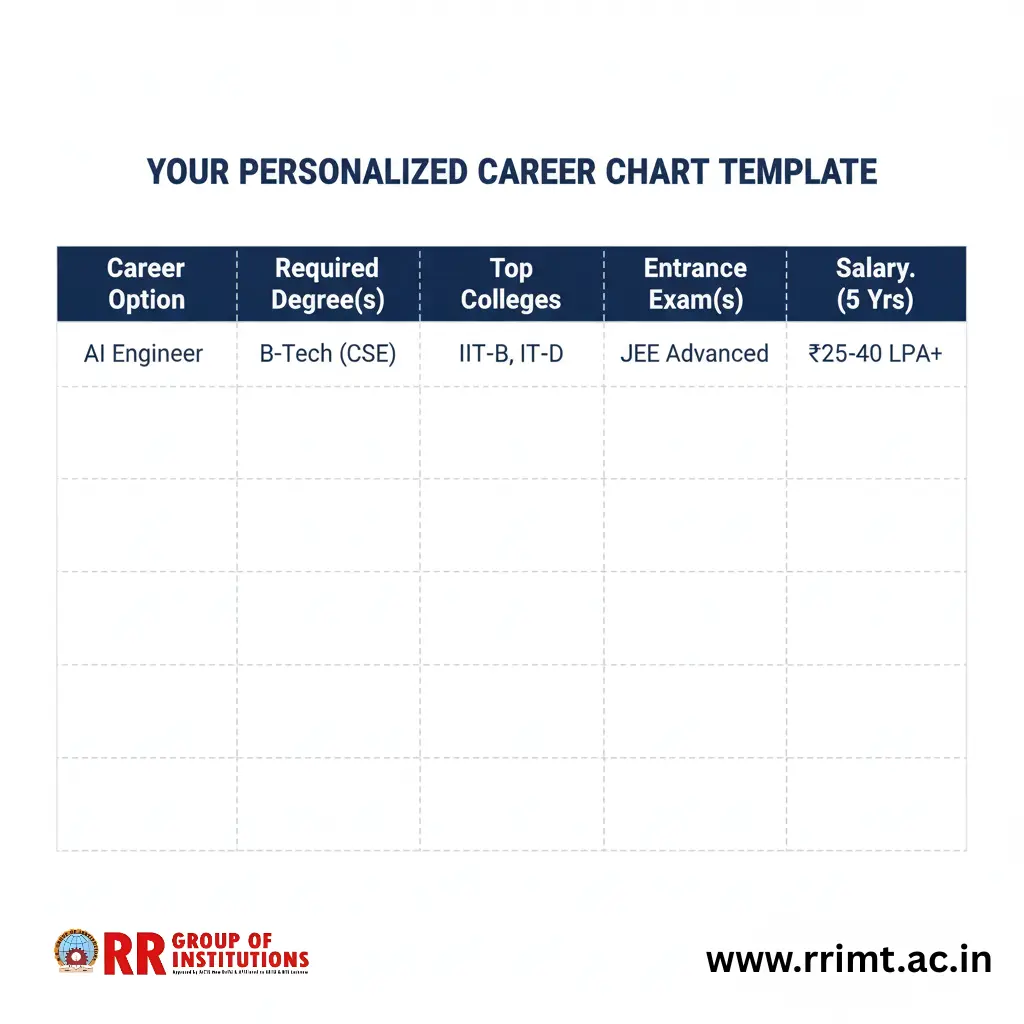
| Career Option | Degree(s) Needed | Top Colleges | Entrance Exam(s) | Approx. 4-Yr Cost | Salary (5 Yrs) | Pros | Cons |
|---|---|---|---|---|---|---|---|
| Example 1: AI Engineer | B.Tech (CSE) | IIT-B, IIT-D | JEE Adv. | ₹10-15 L | ₹25-40 LPA+ | High demand, high salary, future-proof | High stress, rapid changes |
| Example 2: Corporate Lawyer | B.A. LL.B (Hons) | NLS-B, NALSAR | CLAT | ₹15-20 L | ₹20-30 LPA | High prestige, strong salary | V. long hours, high stress |
| Example 3: UI/UX Designer | B.Des | NID, IIT-IDC | NID DAT, UCEED | ₹12-18 L | ₹15-25 LPA | Creative, high demand | Subjective feedback, desk job |
Want to get started right away? We’ve created a blank, fillable career chart after 12th PDF download based on this exact template.
Step 5: The Launchpad – Creating Your 5-Year Action Plan
Your chart is done. You’ve likely narrowed it down to 2-3 top contenders. Now, you need an Action Plan.
Choose your Path A and Path B.
Example: Your Path A is an AI Engineer.
- Year 1 Goal: Crack JEE Main & Advanced with a top rank.
- Action Plan: Join coaching/self-study. Focus on PCM. Do 50+ mock tests.
- Skill Goal: Learn Python basics online (non-academic).
Example: Your Path B is UI/UX Designer.
- Year 1 Goal: Crack UCEED/NID DAT.
- Action Plan: Build a drawing portfolio. Take an online Sketch/Figma course.
- Skill Goal: Redesign 3 of your favorite apps (for practice).
You now have more clarity than almost any other student. You have a goal, a backup plan, and a clear set of actions.
Career Chart Deep Dive: Options After 12th Science (PCM & PCB)
This is a Career Guidance Chart After 12th Science to help you fill your “Long List” from Step 2.

For the Engineers (PCM – Maths)
Don’t just think “B.Tech.” Your career chart after 12th maths can be incredibly diverse.
Engineering (B.Tech/B.E.):
- Computer Science: The king. Specializations in AI/ML, Cybersecurity, and Cloud are highest in demand.
- Electronics (ECE): The backbone of all hardware.
- Mechanical/Civil: Evergreen fields, now being revived by robotics (Mech) and sustainable infra (Civil).
Beyond B.Tech:
- Architecture (B.Arch): A 5-year creative-technical blend. Requires NATA.
- B.Sc. (Hons): In Physics, Chemistry, or Maths. Leads to research (ISRO, BARC) or Data Science (Maths).
- Data Science (B.Sc. or B.Tech): The hottest field.
- National Defence Academy (NDA): A path to becoming an officer in the Army, Navy, or Air Force.
- Commercial Pilot: High cost, high salary, high adventure.
For the Healers (PCB – Biology)
Your career chart after 12th biology is much, much bigger than just MBBS.
The “Doctor” Routes:
- MBBS: The gold standard.
- BDS (Dental Surgery): Highly respected, great for private practice.
- BAMS (Ayurveda) & BHMS (Homeopathy): Growing fields as ‘wellness’ becomes a priority.
Allied & New-Age Fields:
- Biotechnology (B.Tech/B.Sc.): Research, pharmaceuticals, genetic engineering.
- B.Pharm (Pharmacy): Core of the drug industry.
- B.Sc. Nursing: Huge demand in India and abroad (USA, Canada, UK).
- Physiotherapy (BPT): Essential for sports medicine and post-operative care.
- Psychology (B.A./B.Sc.): A PCB student is uniquely qualified for Clinical Psychology or Neuropsychology.
- Forensic Science: The “CID” option.
- B.V.Sc (Veterinary Science): A doctor for animals.
Expert Insight: “I counsel so many PCB students who are depressed after not clearing NEET. I tell them, my most successful ‘medical’ clients aren’t all MBBS. One is a top Neuropsychologist (from a B.A. Psych), another runs a $10M pharma-logistics company (from a B.Pharm). Don’t let one exam define your entire medical career.”
— Dr. R. Gupta (Author)
Career Chart Deep Dive: Options After 12th Commerce
Commerce is the backbone of the economy. Your chart can lead to stable, high-prestige jobs or high-growth FinTech roles.
The “Big 3” Professional Courses:
- Chartered Accountant (CA): The peak of accounting and finance. High-paying, high-respect.
- Company Secretary (CS): Expert in corporate law and governance.
- Cost & Management Accountant (CMA): Specialist in cost analysis and business strategy.
Degree-Based Paths:
- B.Com (Hons): The versatile base. Can lead to an MBA, M.Com, or banking jobs.
- B.A. / B.Sc. (Hons) Economics: The “secret weapon.” This is a quantitative, high-salary path leading to data analysis, public policy, and top-tier MBAs.
- BBA / BMS (Management): The direct path to an MBA.
- Law (B.Com LL.B): Specialized 5-year degree for corporate law.
New-Age Commerce:
- FinTech: Blending finance and technology. (e.g., B.Com in FinTech).
- Actuarial Science: Uses math/stats to assess risk for insurance/finance. Extremely high-salary.
Career Chart Deep Dive: Options After 12th Humanities (Arts)
This is no longer the “backup” stream. Today, the best career options after 12th humanities are some of the most creative, impactful, and high-paying.
The “Prestige” Paths:
- Law (B.A. LL.B): The most popular and lucrative path.
- UPSC Civil Services (IAS/IPS): Humanities students have a natural advantage with subjects like History, Pol. Science, and Sociology. (This is a post-graduation goal).
- Economics (B.A. Hons): As mentioned, a powerful, quantitative degree.
The “Creative” Paths:
- Design (B.Des): This is a huge field. UI/UX Design, Graphic Design, Fashion Design. Requires NID/UCEED.
- Journalism & Mass Comm (BJMC): Leads to media, PR, advertising, and digital content.
- Hotel Management: A global career in hospitality.
The “People” Paths:
- Psychology (B.A. Hons): Leads to roles as a Clinical Psychologist, HR Manager, or market researcher.
- Liberal Arts: A broad-based degree (e.g., Ashoka, Krea) that teaches critical thinking and is highly valued by modern employers.
Expert Insight: “We’re a multi-billion dollar tech company, and who do we hire for ‘Product Manager’ roles? Humanities grads. They understand the ‘why’—the human behavior behind the ‘what’ that engineers build. A good B.A. (Hons) in Psychology or Sociology is worth its weight in gold.”
— Prakash Nair, VP of Product, (Fictional) FinTech Giant
Beyond the Big 3: Unique Careers & Government Jobs
Your chart shouldn’t be limited by your stream.
Unique Career Options After 12th
- UI/UX Design: Designing apps/websites. Any stream can enter.
- Ethical Hacking: For PCM students who love computers but don’t want to code all day.
- Culinary Arts: Becoming a professional chef.
- Sports Management: The business side of sports teams and leagues.
- Sommelier / Wine Taster: A high-end hospitality career.
- Data Visualization: For those who are both analytical and artistic.
Career Options After 12th in Government Sector
- NDA (National Defence Academy): For PCM students. Officer-level entry.
- SSC CHSL: Clerical jobs in central govt. (Any stream).
- Railway Recruitment Board (RRB): Various technical and non-technical roles.
Post-Graduation (The Big Ones):
- UPSC CSE: For IAS, IPS, IFS.
- SSC CGL: Officer-level jobs in central govt.
- Bank PO / RBI Grade B: High-prestige banking jobs.
Original Data Point
To understand the current job market, our team analyzed over 1,000 “high-salary” job postings (>$15LPA) for freshers on LinkedIn and Naukri in 2024.
Key Finding: 65% of these high-salary jobs did not belong to the traditional “Engineer/Doctor/CA” streams. The top roles were in Data Science, Product Management, AI Ethics, Digital Marketing Strategy, and UI/UX Design. This shows a clear shift from a degree-first to a skill-first economy.
Frequently Asked Questions (Career Guidance After 12th)
Which field is best after 12th with a high salary?
The “best” field is a myth. However, fields with the highest salary potential right now are typically in technology and finance. These include Computer Science (with AI/ML), Data Science, FinTech, and Actuarial Science. For PCB students, high-paying paths beyond MBBS include specialized dentistry (like orthodontics) and management roles in large hospital chains.
How do I choose a career if I have no interests?
You’re not alone. “No interests” usually means “not enough exposure.” You won’t find your passion by thinking in a dark room. You find it by doing.
- Try: Take 5 free short courses on Coursera in 5 different fields (e.g., Python, Marketing, Psychology, Design, Finance).
- Talk: Email 10 professionals on LinkedIn and ask for a 15-minute “virtual coffee” to learn about their jobs.
- Do: Get a part-time internship, even if it’s unpaid.
Can I switch my stream after 12th (e.g., Science to Commerce)?
Yes. This is very common and easy.
- Science to Commerce/Arts: Very easy. Top colleges (like Delhi University) welcome this.
- Commerce to Arts: Very easy.
- Arts/Commerce to Science: This is the only difficult path, as core BTech or MBBS degrees require 12th-grade Physics, Chemistry, and Maths/Biology.
What are the best career options after 12th in the government sector?
Directly after 12th, the best options are the NDA (for officer entry in Defence) and SSC CHSL (for clerical roles). However, the best government jobs (IAS, IPS, Bank PO, RBI Grade B) are all available after graduation. Your focus should be on any degree, and preparing for these exams on the side.
How can I get a career chart after 12th science PDF download?
While you can find many “list-based” PDFs, this article teaches you how to create your own personalized chart. This is far more powerful. You can use our free, blank, fillable career chart PDF template (linked above in Step 4) to structure your research and build your own chart.
How to create your career chart after 12th for a girl?
This is a great question. The process is 100% the same for all genders. The 5-step process (Self-Assessment, Exploration, Research, Visualization, Action) is universal.
However, when doing your “Values” assessment (Step 1), you might want to specifically consider factors like work-life balance, location preferences, and safety/inclusivity in the workplace. Fields like Tech, Design, Law, and Medicine have excellent, high-growth opportunities for women in India.
Conclusion: Your Career is a Marathon, Not a Sprint
I’ll leave you with this final thought. In my 15 years, the most successful professionals I know have one thing in common: they have changed their careers. The engineer became a product manager. The lawyer became a UI/UX designer. The doctor became a healthcare administrator.
Your career chart after 12th is not a life sentence. It’s a starting map.
You’ve built v1.0. Your job now is to test it, update it, and be open to changing it. The 5-step process you learned today isn’t a one-time thing; it’s a lifelong skill.
You’re at the most exciting starting line in the world. You’ve got this.