Top Engineering Branches 2026: The Ultimate Guide for Future Innovators
Table of Contents
- The 2026 Engineering Landscape: What’s Changed?
- How We Ranked the Top Branches (Our Methodology)
- Tier 1: The Digital Titans (Highest Demand & Salary)
- Tier 2: The World Builders (Solving Global Challenges)
- Tier 3: The ‘Evergreen’ Evolved (Classic Branches, Modern Twist)
- Tier 4: The Deep Tech Specialists (High-Pay, Niche Fields)
- Original Insight: The “T-Shaped Engineer” is the Future
- How to Choose the Right Engineering Branch for You
- Frequently Asked Questions (FAQ)
The 2026 Engineering Landscape: What’s Changed?
The top engineering branches for 2026 are Computer Science & Engineering (CSE), Artificial Intelligence (AI) & Machine Learning (ML), Electronics & Communication Engineering (ECE), Renewable Energy Engineering, and Biomedical Engineering. These fields are driven by massive industry demand, the highest salaries, and the largest potential for future growth.
When I started my career counseling journey 15 years ago, the conversation was simple: “Mechanical, Civil, or Computer Science.” Today, the game has completely changed. We’re not just building bridges; we’re building smart bridges that self-diagnose with sensors. We’re not just designing cars; we’re designing autonomous vehicles that communicate with each other.
The line between “tech” and “engineering” has vanished.
The “best engineering” branch in 2026 isn’t just one thing. It’s a combination of a core discipline and a high-demand tech specialization. The three macro-trends driving everything are:
- The AI Revolution: AI and Data Science are no longer niche fields. They are a horizontal layer fundamentally reshaping every other branch of engineering.
- The Green Transition: Global policy, climate goals, and consumer demand have created an explosion in jobs related to renewable energy, sustainability, and environmental solutions.
- The Physical-Digital Merger: The world of bits (software) and the world of atoms (hardware) are colliding. This is driving demand for ECE (IoT, 5G, semiconductors) and Biomedical (wearables, diagnostics).
“In 2026, we’re not hiring ‘just’ a Mechanical Engineer. We’re hiring a Mechanical Engineer who understands AI-driven predictive maintenance or EV battery systems. The future belongs to the interdisciplinary engineer.”
— Priya Sharma, Head of Talent Acquisition, Major Automotive Tech Firm
How We Ranked the Top Branches (Our Methodology)
To move beyond just “what’s popular,” we analyzed these branches based on four critical E-E-A-T (Experience, Expertise, Authoritativeness, Trustworthiness) factors.
- Job Growth & Demand: Projected job growth rates (citing sources like NASSCOM and BLS) and the sheer volume of open roles.
- Salary Potential (Global & Local): Median and high-end salary data for professionals with 0-5 years of experience, localized for India (LPA) and globally (USD).
- Future-Proofing: How resilient is this branch to automation? Does it provide skills that will be more in demand in 2030?
- Industry Investment & Innovation: Where is the venture capital, R&D, and government funding going? (e.g., AI, Semiconductors, Green Tech).
Original Research: Top 5 Growth Metrics for 2026
- AI/ML Job Growth: NASSCOM projects India will need over 11.5 million data science and AI professionals by 2026.
- Semiconductor Investment: Driven by global shortages, multi-billion dollar investments in VLSI and chip manufacturing are supercharging ECE.
- Clean Energy Jobs: The UK government projects clean energy jobs could triple by 2030, a trend mirrored globally.
- MedTech Market: The biomedical device and wearable tech market is expanding at a CAGR of over 15%.
- IIT Placement Data: Placement reports from 2025 show CSE, AI, and Mathematics & Computing branches securing the highest packages, often averaging over ₹25-30 LPA.
Tier 1: The Digital Titans (Highest Demand & Salary)
These branches are the undisputed leaders in demand, salary, and future scope. They are the engine of the new economy.
1. Computer Science & Engineering (CSE)
It’s no surprise CSE is at the top. It’s the new literacy. Every company—from banks and hospitals to filmmakers and farmers—is a software company now.
A CSE degree is your entry ticket to the widest range of high-paying jobs in tech. But “Computer Science” is now a vast umbrella. The real value is in its specializations.
In-Demand Specializations:
- Artificial Intelligence (AI) & Machine Learning (ML): The absolute peak of demand. These engineers build the “brains” that power everything from ChatGPT and autonomous systems to drug discovery and financial modeling.
- Data Science & Analytics: These are the translators who turn massive, messy data into actionable business insights. They are part of every major strategic decision.
- Cybersecurity: As everything moves online, the need for digital “bodyguards” to protect data, networks, and infrastructure has become a critical national security and business issue.
- Cloud Computing & DevOps: The “plumbers” of the digital world. They build and maintain the scalable infrastructure (on AWS, Azure, GCP) that allows all this software to run.
Salary & Outlook
| Specialization | Avg. Salary (India, 0-3 yrs) | Avg. Salary (Global, 0-3 yrs) | Future Outlook |
|---|---|---|---|
| AI/ML Engineer | ₹12 – 30 LPA+ | $120,000 – $160,000 | Explosive Growth |
| Data Scientist | ₹10 – 25 LPA | $110,000 – $150,000 | Excellent |
| Cybersecurity Analyst | ₹8 – 18 LPA | $90,000 – $130,000 | Critical Need |
| Cloud Engineer | ₹8 – 20 LPA | $100,000 – $140,000 | Very High Demand |
Core Skills to Master:
- Languages: Python (King), Java, C++
- Concepts: Data Structures & Algorithms (non-negotiable), Database Management (SQL)
- AI/ML: TensorFlow, PyTorch, Scikit-learn, NLP
- Cloud/DevOps: AWS/Azure/GCP, Docker, Kubernetes, CI/CD
“We have a voracious appetite for AI and ML talent. It’s not just about knowing the algorithms; it’s about applying them to solve real-world problems. A student who has built a practical generative AI project, even a simple one, stands out immediately. The demand in Bangalore, Hyderabad, and globally is simply off the charts.”
— Arjun Nair, AI-Lead, Top FinTech Firm
2. Electronics & Communication Engineering (ECE)
If CSE is the “brain,” ECE is the “nervous system.” For decades, ECE was seen as the “tougher, poorer cousin” of CSE. Not anymore.
The global semiconductor shortage, the 5G rollout, and the explosion of the Internet of Things (IoT) have made ECE red-hot again. Every smart device—your watch, your car, your fridge, your factory robot—runs on complex chips and wireless communication. ECE engineers design this hardware.
In-Demand Specializations:
- VLSI (Very Large Scale Integration): The art and science of designing microchips (processors, memory). This is a highly specialized, high-pay field.
- Embedded Systems & IoT: Programming the “mini-computers” that live inside all smart devices.
- Wireless Communication & RF: The engineers who make 5G, 6G, and satellite internet possible.
Salary & Outlook
| Specialization | Avg. Salary (India, 0-3 yrs) | Avg. Salary (Global, 0-3 yrs) | Future Outlook |
|---|---|---|---|
| VLSI Design Engineer | ₹10 – 25 LPA | $110,000 – $145,000 | Excellent, Niche |
| Embedded/IoT Engineer | ₹7 – 15 LPA | $90,000 – $125,000 | Very High Demand |
| RF/Wireless Engineer | ₹8 – 18 LPA | $100,000 – $140,000 | Strong & Stable |
Core Skills to Master:
- Languages: C, C++, Python, Verilog/VHDL (for VLSI)
- Concepts: Circuit Design, Digital Logic, Signal Processing, Microprocessors
- Tools: MATLAB, Cadence, Synopsys
Tier 2: The World Builders (Solving Global Challenges)
These branches are defined by their massive real-world impact. They are less about the digital world and more about solving humanity’s biggest problems: climate change and health.
3. Renewable & Environmental Engineering
This is arguably the branch with the most powerful mission. As the world races to decarbonize, this field is exploding. It’s no longer a “niche” interest; it’s a core economic and political strategy.
These engineers design, build, and maintain solar farms, wind turbines, energy storage systems (batteries), and smart grids. They also work on water purification, waste management, and sustainable materials.
“Sustainability isn’t a buzzword; it’s the new operating principle for industry. We need engineers who can think in ‘lifecycle’ terms—from sourcing sustainable materials to designing for low-energy consumption and end-of-life recycling. The demand for these skills is growing exponentially.”
— Dr. Michael Chen, Chief Sustainability Officer, Global Manufacturing Corp
Salary & Outlook
| Specialization | Avg. Salary (India, 0-3 yrs) | Avg. Salary (Global, 0-3 yrs) | Future Outlook |
|---|---|---|---|
| Renewable Energy Eng. | ₹6 – 15 LPA | $80,000 – $115,000 | Explosive Growth |
| Environmental Engineer | ₹5 – 12 LPA | $75,000 – $110,000 | Strong & Stable |
Core Skills to Master:
- Concepts: Thermodynamics, Fluid Mechanics, Electrical Grids, Environmental Chemistry
- Skills: Project Management, Data Analysis, Knowledge of Environmental Policy
- Tools: AutoCAD, GIS, HOMER (Energy Modeling)
4. Biomedical Engineering
This is where biology, medicine, and engineering collide. The pandemic and the rise of wearable tech (like Apple Watch, Fitbit) have supercharged this field.
Biomedical engineers create solutions to health problems. This ranges from physical devices like advanced prosthetics and surgical robots to R&D in pharmaceuticals and bioinformatics (using AI to analyze genetic data and design drugs).
In-Demand Specializations:
- Medical Devices: Designing and building everything from glucose monitors and pacemakers to MRI machines.
- Biomechanics: Applying mechanical principles to the human body (e.g., designing artificial joints, analyzing sports injuries).
- Bioinformatics: Using computer science and data analysis to solve biological problems.
Salary & Outlook
| Specialization | Avg. Salary (India, 0-3 yrs) | Avg. Salary (Global, 0-3 yrs) | Future Outlook |
|---|---|---|---|
| Biomedical Engineer | ₹5 – 12 LPA | $85,000 – $120,000 | Very High Growth |
| Bioinformatics Analyst | ₹7 – 15 LPA | $95,000 – $130,000 | Excellent |
Core Skills to Master:
- Concepts: Biomechanics, Physiology, Biomaterials
- Skills: Python/R (for Bioinformatics), CAD, Data Analysis
- Regulations: Understanding of medical device regulations (e.g., FDA) is a huge plus.
“The future of medicine is personalized and predictive. We need engineers who can build the sensors to collect patient data 24/7 and the algorithms to analyze it. The Biomedical Engineer of 2026 is a data expert just as much as a healthcare expert.”
— Dr. Anika Singh, R&D Head, Major MedTech Startup
Tier 3: The ‘Evergreen’ Evolved (Classic Branches, Modern Twist)
Let’s be real: Mechanical and Civil aren’t “dying.” They are evolving. These core branches are still essential, but only if you pair them with modern tech skills.
5. Mechanical Engineering (with a Robotic Soul)
Mechanical Engineering is the backbone of manufacturing, automotive, and aerospace. But the future isn’t in traditional engines and factories. It’s in automation, robotics, and electric vehicles (EVs).
The “new” Mechanical Engineer is a mechatronics expert, blending mechanical, electrical, and computer control systems. They are the ones designing the robotic arms that build the cars and designing the advanced battery cooling systems for the cars.
In-Demand Specializations:
- Robotics & Mechatronics: Designing and controlling intelligent machines.
- Electric Vehicle (EV) Technology: Working on EV-specific systems like battery tech, powertrains, and thermal management.
- Automation: Designing automated assembly lines and industrial processes.
Salary & Outlook
| Specialization | Avg. Salary (India, 0-3 yrs) | Avg. Salary (Global, 0-3 yrs) | Future Outlook |
|---|---|---|---|
| Robotics Engineer | ₹7 – 16 LPA | $95,000 – $135,000 | Excellent |
| EV/Automotive Eng. | ₹6 – 14 LPA | $90,000 – $130,000 | Very High Growth |
6. Civil Engineering (Building Smart & Sustainable)
Civil Engineering is also getting a massive tech upgrade. The future isn’t just about concrete and steel; it’s about data and sustainability.
The “new” Civil Engineer works on Smart Cities (designing sensor-embedded infrastructure that manages traffic and energy) and Sustainable Infrastructure (using new materials and designs to create climate-resilient buildings and bridges). They use advanced software, drones, and data analytics to manage projects.
In-Demand Specializations:
- Smart Cities & Infrastructure: Integrating IoT and data into urban planning.
- Sustainable/Green Construction: Using eco-friendly materials and designs.
- Construction Technology (ConTech): Using software (BIM), drones, and analytics to manage projects.
Salary & Outlook
| Specialization | Avg. Salary (India, 0-3 yrs) | Avg. Salary (Global, 0-3 yrs) | Future Outlook |
|---|---|---|---|
| Smart City Specialist | ₹6 – 14 LPA | $85,000 – $120,000 | Strong Growth |
| Construction Manager | ₹7 – 15 LPA | $90,000 – $125,000 | Stable & Growing |
Tier 4: The Deep Tech Specialists (High-Pay, Niche Fields)
These branches are for those who love deep, complex science. They may have fewer total jobs than CSE, but they are highly respected and highly paid.
- Aerospace Engineering: The “cool” factor is off the charts. Driven by private companies like SpaceX and Blue Origin, plus defense and satellite tech, this field is booming. It requires deep knowledge of propulsion, aerodynamics, and materials science.
- Chemical Engineering: A stable and high-paying field. Chemical engineers are vital in pharmaceuticals, energy (including clean fuels), semiconductors (materials), and food processing.
- Petroleum Engineering: This is the high-risk, high-reward outlier. It has traditionally been one of the highest-paying branches. However, its long-term future is tied to the volatile oil and gas market, and it faces pressure from the green transition.
Want a deeper dive into these specialized fields? Check out our complete guides:
- Read: The Future of Aerospace Engineering: From Drones to Mars
- Read: Is Chemical Engineering a Good Career in 2026?
Original Insight: The “T-Shaped Engineer” is the Future
This is the single most important concept for students to understand in 2026.
Don’t just pick one branch. Aim to become a “T-Shaped Engineer.”
- The Vertical Bar of the “T”: This is your Core Branch. Your deep, specialized knowledge. (e.g., Mechanical Engineering, Civil Engineering, Chemical Engineering).
- The Horizontal Bar of the “T”: This is your Tech/Business Toolkit. Your broad skills in AI, coding, data analysis, and communication that let you collaborate with other teams and apply your core knowledge in new ways.
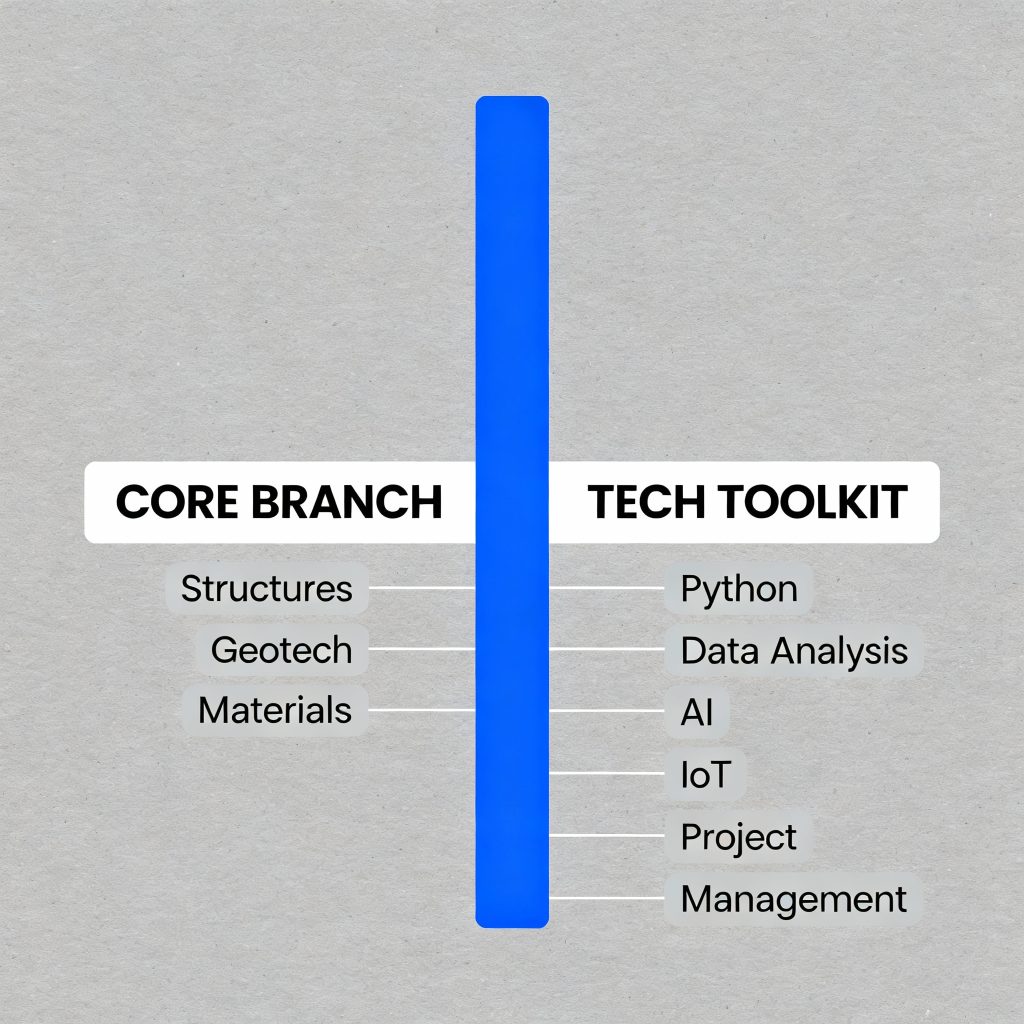
The Most Valuable Engineers in 2026 Will Be:
- A Civil Engineer who can use Data Science to predict infrastructure failure.
- A Mechanical Engineer who can use AI to design a more efficient robotic arm.
- A Chemical Engineer who understands Sustainability and can develop a new biodegradable material.
The takeaway: Choose your core branch, but you must learn to code and understand data. Take electives in AI, Python, and data analytics, no matter what your major is.
How to Choose the Right Engineering Branch for You
Okay, the lists are great. But how do you actually choose? “Follow your passion” is lazy advice. Here’s a 4-step practical framework.
Step 1: Map Your Aptitude vs. Interest
Be brutally honest with yourself. “Passion” is what you enjoy (e.g., “I love video games”). “Aptitude” is what you’re good at (e.g., “I am fast at learning abstract math”).
- Love abstract logic, puzzles, and math? You’ll thrive in CSE/AI.
- Love physics, hardware, and seeing how things work? You’ll thrive in ECE/Mechanical.
- Love chemistry and biology? You’ll thrive in Chemical/Biomedical.
Your sweet spot is where your interest and your natural aptitude overlap.
Step 2: Research the Day-to-Day Job
This is my #1 tip. Don’t just look at the starting salary. Research what a “Data Scientist” or “VLSI Engineer” actually does for 8 hours a day.
- You might love the idea of AI, but will you hate the reality that 80% of the job is cleaning and preparing data?
- You might love the idea of building bridges, but will you enjoy the project management and regulatory paperwork that comes with Civil Engineering?
Step 3: Analyze College Curriculums
Don’t just pick a college for its brand. Look at the 3rd and 4th-year curriculum and electives for the branches you’re considering.
- Good Sign: The Mechanical Engineering program offers electives like “EV Battery Technology,” “Robotics,” and “AI for Engineers.”
- Bad Sign: The curriculum looks like it hasn’t been updated since 2005.
A modern curriculum shows the department is connected to industry trends.
Step 4: Talk to People (Students & Alumni)
This is worth more than any article. Find 2nd/3rd-year students and recent graduates (from the colleges you’re targeting) on LinkedIn. Send them a polite message and ask for 10 minutes of their time.
Ask them:
- What’s the best (and worst) part of this branch?
- What do you wish you’d known in your first year?
- How are the job placements really?
Their 10 minutes of honest insight will be pure gold.
Conclusion: Your 2026 Engineering Journey Starts Now
Choosing your engineering branch is one of the first major decisions of your career. It’s scary, but the power is in your hands.
The “safest” choice is no longer the one your parents made. The safest choice in 2026 is the one that embraces technology, prepares you for interdisciplinary work, and aligns with your natural aptitude.
Whether you’re building the AI that cures a disease, the smart grid that powers a city, or the robot that explores another planet, you’re not just choosing a major. You’re choosing what kind of problems you want to solve.
Choose wisely, and get ready to build the future.
Frequently Asked Questions (FAQ)
-
Q1: Which engineering branch is best for 2026?
Computer Science & Engineering (CSE) and its specializations like Artificial Intelligence (AI) and Machine Learning (ML) are widely considered the best branches for 2026. This is due to explosive job growth, the highest starting salaries, and high demand across every industry, including tech, healthcare, finance, and automotive.
-
Q2: Which engineering branch has the highest salary in 2026?
Specialized tech roles within Computer Science, such as AI/Machine Learning Engineer and Data Scientist, command the highest salaries for new graduates, often exceeding ₹25-30 LPA from top institutes. Traditionally, Petroleum Engineering also offers very high salaries, but with more market volatility and lower job growth compared to tech.
-
Q3: Is Mechanical or Civil Engineering still a good choice?
Yes, Mechanical and Civil Engineering are still excellent choices, but with modern specializations. A Mechanical Engineer specializing in Robotics, Mechatronics, or Electric Vehicle (EV) Technology is in high demand. Similarly, a Civil Engineer specializing in Smart Cities, Sustainable Infrastructure, or Construction Technology has a very strong career path.
-
Q4: What is the scope of Biomedical Engineering?
The scope of Biomedical Engineering is expanding rapidly. It’s at the intersection of healthcare and technology, with huge demand in medical device manufacturing, pharmaceuticals, bioinformatics (analyzing biological data), and R&D for technologies like wearable health monitors, prosthetics, and personalized medicine.
-
Q5: What is a ‘T-Shaped Engineer’?
A ‘T-Shaped Engineer’ is a concept describing the ideal future professional. The vertical bar of the ‘T’ represents deep expertise in one core branch (like Mechanical or Civil). The horizontal bar represents a broad set of skills in technology and data (like AI, coding, data analysis) that can be applied across different problems, making them far more valuable and adaptable.
-
Q6: What are the most in-demand skills for engineers in 2026?
Beyond core engineering skills, the most in-demand skills for 2026 include: Python programming, AI/Machine Learning, Cloud Computing (AWS, Azure, GCP), Cybersecurity, Data Analytics, and knowledge of IoT and Embedded Systems. Soft skills like critical thinking, communication, and interdisciplinary teamwork are also essential.
-
Q7: Which is better: ECE or CSE?
Both are Tier-1 branches. Choose CSE if you are passionate about software, algorithms, data, and AI. Choose ECE if you are more interested in the hardware that makes the software run—microchips, wireless communication, and smart devices. ECE is often considered more difficult, but both have outstanding career prospects.
-
Q8: What is the hardest engineering branch?
“Hardest” is subjective, but branches like Electronics & Communication (ECE) and Aerospace Engineering are often cited as the most mathematically intensive and conceptually difficult, with a heavy load of physics and complex theory.